Movies

New Releases • A-D • E-H • I-P • Q-Z • Articles • Festivals • Interviews • Dark Knight • Indiana Jones • John Wick • MCU
Go behind the scenes and on location
with director Christopher Nolan and the cast of The Odyssey.
Featurette: Universal Pictures
The Odyssey
Directed by Christopher Nolan
Rated R
Returned 16 July 2026
#TheOdysseyMovie • #IMAX • #70mm • #ShotOnFilm
Take I: Press Screening – 13 July 2026, 19:30, Regal Colorado Center IMAX 70mm Film, Denver
Christopher Nolan’s version of The Odyssey is a colossal work of cinematic art.
War Horse
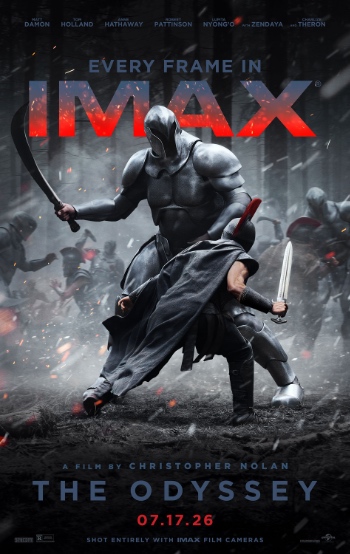
There’s only one opening title card and it simply states, “A time of apparent magic.” It’s so appropriate, as this movie was made with “apparent magic.”
Scattered throughout The Odyssey are scenes depicting the invasion of Troy and the infamous Trojan horse. As the movie progresses, these scenes gain intensity and the scale grows to jaw-dropping levels. The action is real. The people are real. The locations are real. This isn’t an epic laden with the digitized fakery of CGI artifice. This is human spectacle.
Possibly the biggest surprise here has nothing to do with the casting controversies circulating among neophobes (ludicrous), historical costume design criticisms thrown around since the first promotional still image was released (ridiculous) or any narrative fiddling (to be expected). It’s the approach to the visual effects. There was enough of a tease early on as the movie went into production to suggest some of the fantastical creatures encountered might be done using stop-motion technology made famous by Ray Harryhausen in his superb effects for movies centered around Greek mythology. How else? If not with CGI, then by puppetry? But no. If anything, Nolan takes an even more old-school approach, very much in the mindset of “less is more.” It’s cinematic sleight-of-hand at its finest. Some of it even calls to mind the practical horror effects of Tom Savini. Much like the story itself, what was old is new again in so many varied ways when it comes to this Odyssey. And it still feels so fresh.
Watching those scenes of the Trojan horse, its construction and its implementation bring one name to the fore: Cecil B. DeMille. This is grand filmmaking that brings back the humanity to the process of filmmaking and storytelling on a massive scale and it’s truly breathtaking (especially in full-screen IMAX 70mm film).
Much is being made of the movie having been filmed entirely on IMAX film stock. That’s a first for a feature film and it is a major technical milestone in the history of filmmaking and cinematography that can’t be oversold. But more on that in a bit.
Songs of Odysseus
Like Shakespeare and his works, questions abound about the provenance of The Odyssey and Homer’s identity. It’s a story that dates back in written form nearly three millennia. For those unfamiliar with the story “Homer” finally wrote down after prior centuries of the tales being shared and passed down orally – in song – from generation to generation, the central character is Odysseus (Matt Damon) and his actions that challenge Zeus’ Law, bringing the wrath of the gods on him, his army and his loved ones as Odysseus’ return to his home, Ithaca, from Troy becomes an extended voyage – an odyssey – of decades.
Back home, his beloved wife, Queen Penelope (Anne Hathaway), must contend with an array of woefully unqualified suitors (counting as many as 108, according to Homer, by way of Stephen Fry) to ascend to the throne while their son, Telemachus (Tom Holland), holds out hope for the return of the father he never really got to know as a child. Amidst all this, Penelope and Telemachus must also contend with betrayals and criminal conduct as Ithaca’s civilization falls into decline without its king. While Odysseus used the wooden horse as a vessel to invade and conquer Troy, Ithaca was rotting from the inside out by its own homegrown malicious forces and a dramatic decline in basic civility.
Nolan begins near the end of Homer’s tale and skillfully balances a non-linear structure that uses flashbacks across story threads until all the lead characters are brought together for a strong finale. It’s a smart approach that helps bring the dramatic impact of ongoing events back home into a sharper focus and giving more weight to the characters’ challenges at home and abroad, rather than presenting a strictly straight, linear telling. The Odyssey is (fittingly) a long story (12,109 lines of poetry, as counted by Daniel Mendelsohn) and adapting it into a 170-minute feature film is no small task. This narrative aspect is in itself a significant artistic feat.
That beginning – the event that sets the gears of Odysseus’ trials in motion – is the invasion of Troy, which served as a push to end a cataclysmic 10-year war. The famous gift horse (no longer the typical giant toy horse on enormous wooden wheels) is a major facet of a recurring flashback; its power and impact grow as the pieces of the invasion are put together and revisited throughout the course of the movie.
Gods, Monsters and Heroes
The cast and crew have joked about how they were making six or seven movies while traveling the world (the real world!) filming the adventures in exotic locations. In some respects, the movie feels like several different movies, but merely by the range of situations and monsters Odysseus and his crew encounter.
Those episodes include a run-in with a hideous cyclops (which harkens in content but not style to Ray Harryhausen). There’s also a truly creepy episode that takes on the tone of a body horror movie involving the witch Circe (Samantha Morton); it’s almost as if Hitchcock’s shadow is cast on the walls of her cabin.
As those flashbacks to Troy reveal the construction of the horse, there’s even a sense of Steven Spielberg’s Saving Private Ryan and those incredible scenes recreating with unprecedented historical accuracy the Normandy invasion as a group of Odysseus’ soldiers endure some harrowing conditions.
There are also eerie sirens – enchantresses beckoning unsuspecting sailors to their doom – singing out to Odysseus’ crew. They also face giant armored knights and a bodysnatching tentacled sea creature. Not to mention a massive, ship-wrecking whirlpool, a trip to Hades and a whole bunch of angry gods, mostly unseen.
The gods (or god adjacent) on view include Athena, Calypso and Circe. Plus, there’s the infamous daughter of Zeus who has for millennia captivated men and imaginations with her beauty, Helen of Troy (Lupita Nyongo’o), who had a face that launched a thousand ships. But there’s a twist here. Maybe, her husband, King Menelaus (Jon Bernthal), posits, it’s more like the face that launched 500 ships as her face turns to reveal a severe scar.
The overall vibe is a “cast of thousands” epic from the golden days of Hollywood, when directors like DeMille and David Lean brought magnificent images to the silver screen by physically recreating events. As told by Homer, it’s a cast list of more than 120 characters. And some of Nolan’s casting choices are marvelously appropriate even as they at first glance might raise eyebrows. Rapper Travis Scott, for one, plays a character identified only as the Bard, but narratively would fit in as Phemius, albeit with a twist toward the end. A bard, “back in the day,” was a singer, a performer. Scott’s casting (don’t forget his Tenet collaboration with Nolan) is so very fitting. As a bit of future trivia, Scott’s voice is the first one heard in The Odyssey as the Bard – following that oral tradition – performs one of the “songs” of Odysseus.
Maybe one outcome of all this will be inspiring people to drop off social media for a minute and read Homer’s books. Well, a guy can dream, anyway. Reading is most certainly on the decline these days, as is modern civilization. The parallels are all right there, even as Odysseus makes a quip about the small pool of people with the ability to write songs.
Ludwig Göransson discusses the music of The Odyssey.
Featurette: Universal Pictures
Narrative Chops
As with any adaptation, narrative compromises are a practical requirement. Some go to extreme lengths to completely reimagine a work, such as Robert Zemeckis’ magnificent overhaul of Winston Groom’s Forrest Gump and Anthony Minghella’s masterful version of Michael Ondaatje’s The English Patient. Here, Homer’s sprawling source material transforms into a briskly paced experience for audiences removed by millennia from Homer’s day.
To make that happen, some elements are missing and some of those missing pieces are missed. One is the cyclops encounter in full; Nolan keeps it to the basics and skips the cleverness of Odysseus identifying himself as “Nobody.” This is a tough choice and one that slightly undercuts the build-out of Odysseus as a cunning, clever leader of people. Instead, the gist is there through conversations far afield and at home, particular among those who love the man. Indeed, at one point a comment is made, “His cleverness is going to get him in trouble.” Still, it would’ve been helpful to assert and reassert more of Odysseus’ leadership style and qualities.
Homer’s work also includes a surprising amount of sex; one can only imagine it as of the more raucous variety as it is enjoyed between puny mortals and licentious goddesses. On the one hand, the offspring are bypassed altogether. On the other hand, it opens casting possibilities that help create a theatrical shorthand. Not every female encounter needs to be filled with sexual tensions involving a hot goddess to make the story work and keep the movie moving.
With that, the seven-year relationship between Odysseus and Calypso (Charlize Theron) takes on a different, more grounded tone while the encounter with Circe is allowed to go all-out creepy. The change to Circe is a big one, but it works in service to this particular Odyssey experience, one that ends with an entertainingly intense climax.
As an R-rated feature, the violence is a key consideration. But even it is kept to a relatively modest level even when compared to some recent PG-13 ventures. That said, it’s still helpful as an indication this isn’t a children’s movie. The subject matter, the dialogue and the themes require more concentration than those mythological classics of the 1960s-1980s.
Anarchy & Pain
In typical Nolan fashion, there’s more to unpack watching The Odyssey than can be reasonably digested in one viewing. There’s the narrative, the technical execution. But then there’s so much beneath the surface that needs to settle into the mind. It’s densely, richly packed with ideas.
Some of these thoughts involve the casting. It’s already been mentioned Travis Scott has proven himself to be a credible actor. But what about Athena? Why Zendaya?
It’s genius as a cinematic interpretive element.
A goddess (or god) doesn’t necessarily have to appear the same to all people at all times. In this case, Athena, Odysseus’ war strategist, appears to Odysseus as (and this isn’t a spoiler) one of the young women he sees executed during the Troy invasion. From there, the intensity of those scenes, along with Odysseus’ thoughts on war, the downfall of civilization and the gods hit home harder and harder. And Athena seemingly starts to appreciate her complicity in the figurative wheels that have been set in motion.
Consider also the recurring idea that strangers might be a god in disguise, so they should be welcomed and treated with respect. As Odysseus observes, the clearest view of a man is from below.
In so many respects, this one holds a mirror to modern civilization. What is a civilization and how does it hold itself together? It’s in part through checks and balances that keep destructive forces at bay (in this case, it’s the “people from the sea”). It’s also about understanding the structures – not just those stunning buildings that have stood for centuries, but also the processes, ideas and ideals – that can so easily lose their meaning. It’s about respecting the law (most especially Zeus’ Law), the gods and fellow citizens.
There’s a hardcore feminist theme screaming out from Penelope and Circe as they rail against the societal norms they must follow. The latter, a witch who transforms men into various wildlife: tigers, panthers, cougars, lions, deer. But with Odysseus’ crew of soldiers, pigs are the creature of choice. Gluttonous. Disgusting.
And those elements are the more obvious ones.
There are deeper, darker thoughts about the downfall of civilization – including challenges with literacy rates – while still holding out hope that civilization will be able to rise again.
Odysseus comes to a brutal realization: “To burn the walls of Troy is to burn the world entire.” It’s a dark thought, but it’s complementary to the Talmud’s “To save one life is to save the world entire.”
IMAX 70mm Film
Go behind the scenes with Christopher
Nolan, cinematographer Hoyte Van Hoytema and the cast as they film The Odyssey exclusively with IMAX
cameras.
Featurette: Universal Pictures
So. The Odyssey is the first movie shot entirely with IMAX cameras. Great. But what does that mean?
Its significance can’t be overstated and it represents the culmination of Nolan working with IMAX for more than two decades – starting in 2005 with the reformatting of Batman Begins for IMAX screens – to overcome the format’s technical challenges, the noise of the cameras being the primary obstacle to filming dramatic, dialogue-heavy scenes. Additionally, a wholly new black-and-white IMAX film stock was created for Nolan’s use on Oppenheimer, released in 2023.
It means now when you go to a “full-size” IMAX theatre, the kind equipped with the huge IMAX screen originally found exclusively in natural science museums showing documentaries like Everest, you’ll view the entire movie in the almost square 1.43:1 aspect ratio that fills the screen from floor to ceiling.
Note: Not all IMAX theatres are created equal; many multiplexes have an “IMAX Lite” or (more bitterly) “LIEmax” variant that is a smaller screen while still adhering to certain other IMAX presentation standards. At last count, there are only 25 theatres in the United States and 41 locations in total around the world showing The Odyssey in IMAX 70mm film, Nolan’s preferred presentation format. (Find locations on IMAX.com.)
Praise be to Zeus! Denver is on the map with the Regal Colorado Center. But, of course, there’s a price for admission: tickets are $32 each. (Hey, there’s actually a human being in the projector room keeping an eye on things and ensuring the movie stays in focus.) As a slight tangent, when The Dark Knight screened ahead of its opening at the Colorado Center IMAX, the projector overheated once. But the movie resumed. Then it overheated again. It was an extended stoppage that ultimately became an unrecoverable situation. Ultimately, the screening was canceled somewhere around the third act. Passes were given out for future screenings and this writer went back in the wee hours of opening day (perhaps as early as a 6:00 AM showtime) to see how it all ended before heading out to the day job. The projection booth went digital after that. It’s such a welcome relief to have beautiful film back in the house.
But there’s more. With IMAX cameras used for the entire production, that means the movie can be a full theatrical experience without shifting aspect ratios (typically between expansive set pieces in IMAX and dramatic scenes in scope). There are the grand landscapes and action sequences in the huge format, of course. But now there are also close-ups. Scenes of two people talking and it’s their faces that fill the entire frame, the camera shifting focus from one face to the other.
That – as a purely technical concept – is mighty exciting in and of itself.
Take II: First Public Show – 16 July 2026, 15:00, Regal Colorado Center IMAX 70mm Film, Denver • F18

This release is something special and the theatre chains are finally figuring it all out.
At concessions, there were the ultra-popular IMAX camera popcorn bucket ($50) that had previously (rapidly) sold out online and the huge Trojan horse popcorn bucket ($70; the popcorn pours out of the horse’s belly). They officially went on sale 75 minutes before the first show and each was limited to one per ticketed 70mm film attendee. The buckets include a separate large popcorn and free (!) refills.
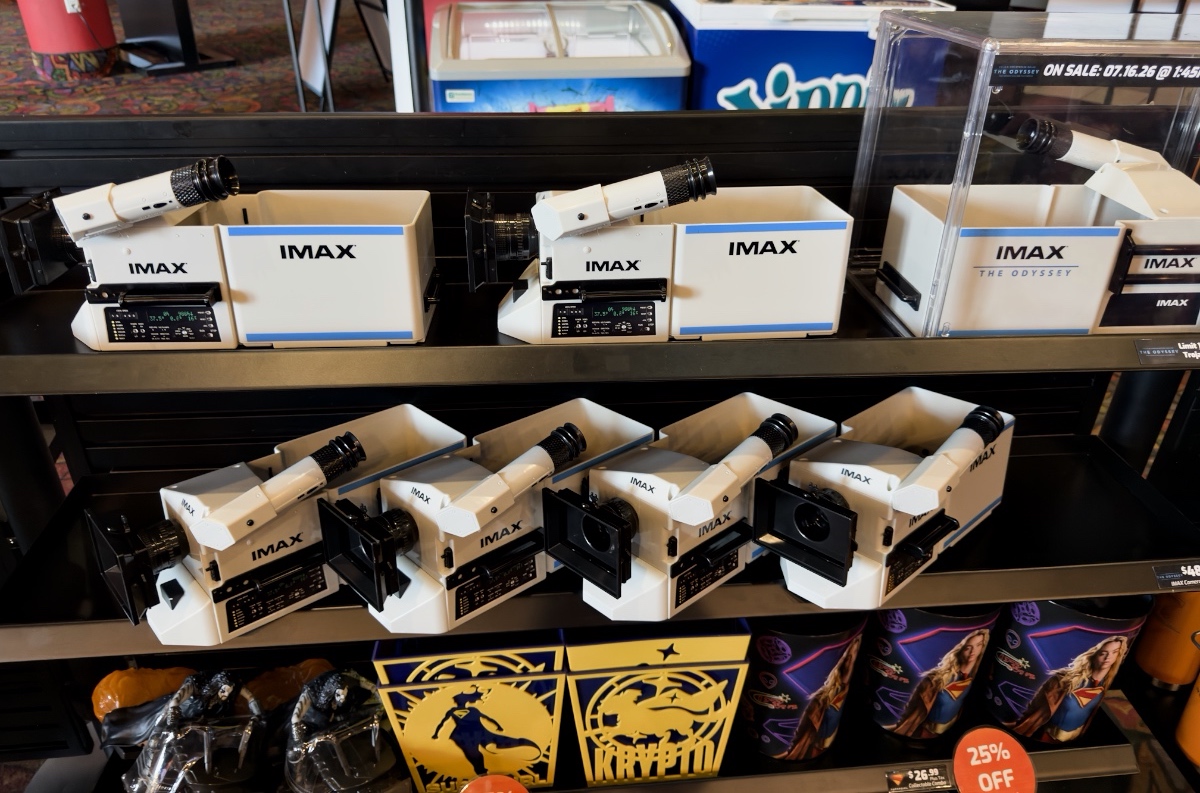
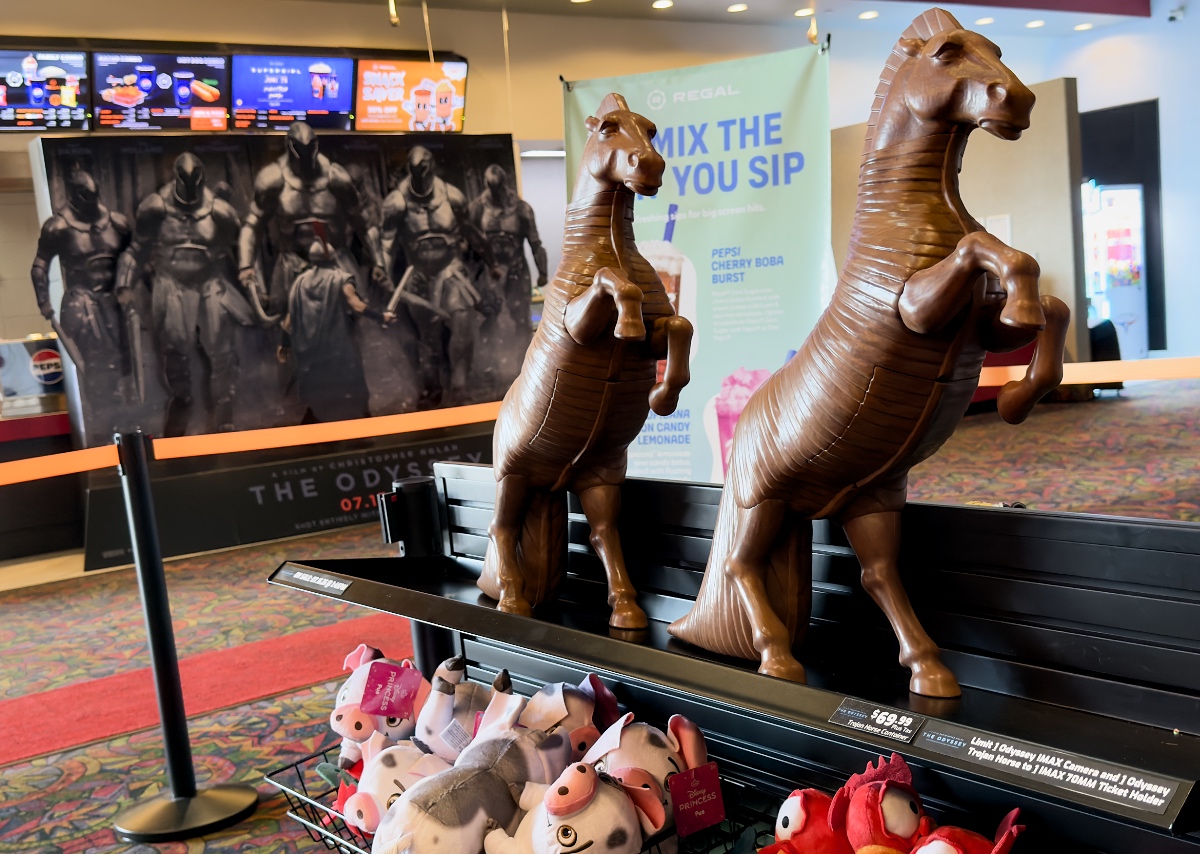
The jury’s still out, but this next one might be the nerdiest photo I have ever taken. Ever.
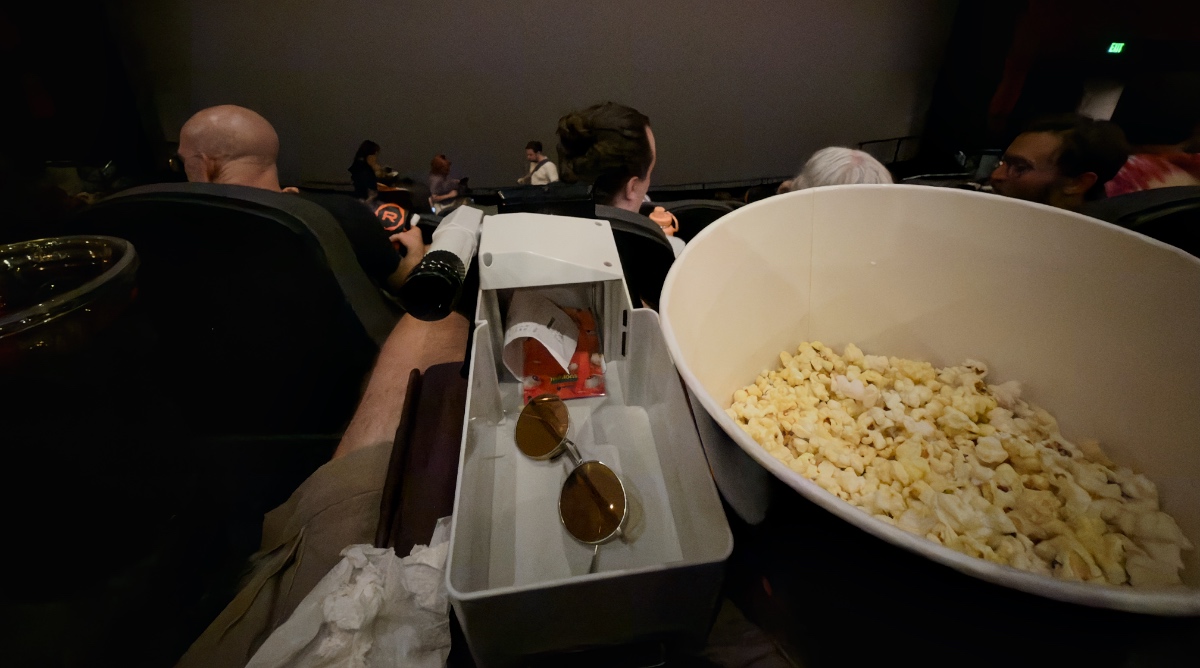 The IMAX camera popcorn
bucket in my lap with a large soda to the left and a large popcorn to the right. Yeah. That popcorn’s almost half gone and the movie hasn’t even started yet. I felt like one of Circe’s pigs.
The IMAX camera popcorn
bucket in my lap with a large soda to the left and a large popcorn to the right. Yeah. That popcorn’s almost half gone and the movie hasn’t even started yet. I felt like one of Circe’s pigs.
I saw the IMAX camera popcorn bucket on sale three times on IMAX.com, but I held off as part of my personal attempt at something resembling austerity. That said, I am a weak human and couldn’t resist it once it was actually in my hands.
Before the first public screening started, a human being came to the front of the auditorium, thanked the crowd, explained it’s a thrill to have film back in the house. There is even a real person operating the projector! The woman down at the front of the auditorium then showed the free opening day poster we would all receive, then said we’d be handed it on the way out so we wouldn’t have to hold onto the poster (rolled and rubber banded) during the show. She also noted the show would start 10 minutes late with intention to allow those who “didn’t get the note” it’s 70mm film and there’s only one trailer, no commercials as a bonus factor of using the rare presentation equipment. There simply aren’t an array of trailers and commercials available in the format.
And that one trailer turned out to be rather special. Dune: Part Three, roughly four minutes showcasing full-screen footage and thunderous sound. It started with a note from director Denis Villeneuve expressing his deepest gratitude to Christopher Nolan for “allowing” this trailer (a Warner release attached to the Universal feature).
But the image was jittery. It’s a film projector sensation, something probably the vast majority of the sold-out crowd had never seen before. They stopped the projector and the man in the booth fixed it.
The rest is Denver (film) history.
On the way out, I noted the Odyssey bucket shelves were wiped clean, but I assumed they were being rationed for future screenings.
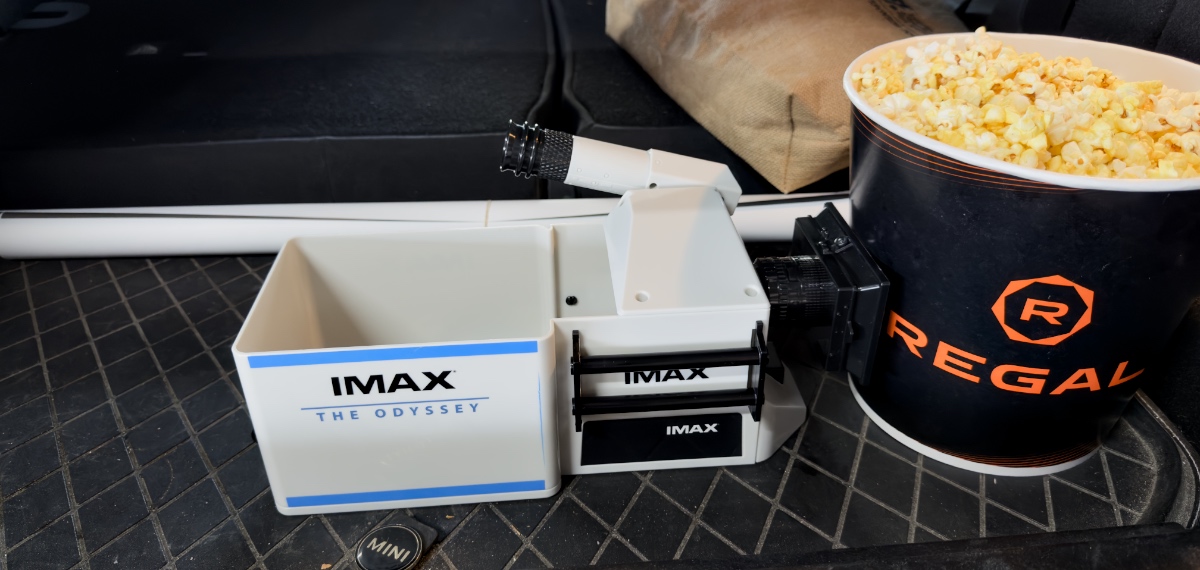 Or course, this photo
runs a close second in the nerd factor. The “goods” in the boot of my MINI Cooper S. Note the full bucket of popcorn. (Free refills!)
Or course, this photo
runs a close second in the nerd factor. The “goods” in the boot of my MINI Cooper S. Note the full bucket of popcorn. (Free refills!)
NNOOOOOOOOOOOOO!!
The evening of Monday, 20 July, the news broke of the broken projector.
Apparently the Colorado Center’s IMAX film projector conked out on Saturday and had been out of commission for the past couple days. Back when the projector broke during The Dark Knight, my understanding was the projector was overheating. That’s why a short wait allowed it to cool enough to continue. But a second episode proved to be too much.
This time, it sounds like the issue is more mechanical. Problems also popped up elsewhere, including at the only other theatre in Colorado similarly equipped, the Cinemark Carefree in Colorado Springs. But that one was able to resume operations relatively quickly.
Given the state of projection systems these days and the prevalence of digital, these IMAX film projectors are no longer in production; even parts are hard to source, if not impossible. So it sounds like it’s time to reimagine this part of the experience: the projection system itself.
To Regal’s credit, the option is given to either get a refund or see the movie at the ticketed time in IMAX digital and receive a voucher for a ticket at a later date (up to 18 months out), including Odyssey in IMAX 70mm film.
For my third viewing, I took the second option, as did the vast majority of people. For me, it was an opportunity to compare the digital experience to the film version.
Of course, the movie holds the same power. The biggest difference is in the frame itself. The 70mm film version fills the entire 70-foot tall screen. The digital version is cropped to a 64-foot frame, with 3 feet shaved off the top and 3 feet off the bottom. The picture is brighter in digital, allowing for more details to come through. I contend (unofficially and unscientifically) the darker film presentation is old-school cheating, keeping the bulb dimmer and, in theory, helping prevent overheating, which is of particular consideration for a movie that runs nearly 3 hours. When it comes to the sound, the film presentation wins out with a thunderous, immersive audio experience.
This is all unprecedented, particularly in Denver. Since opening, 8:00 (8 AM!) shows have been added and now new 2:00 (2 AM!) screenings have been added. They're all selling out. Astounding. Exciting. Well deserved. It’s so uplifing to see the public rally around this experience.
Take III: 21 July 2026, 11:40, Regal Colorado Center IMAX Digital, Denver • D14
I now appreciate how Nolan has drawn in full Odysseus as a man, a husband and a leader. Some of the most delineative comments come from Athena. And it’s the result of an extremely carefully written screenplay, coupled with a stunning performance from Matt Damon. Not only did he shred his body to get in shape for this faulty hero, he shredded his vocal chords to get that oh-so effective raspiness to his voice as the strains of the years, the sun and all those other elements take their toll.
It’s striking how Odyssey – a tale that’s endured millennia – has reformed filmmaking by way of Nolan’s genius approach.
It is analog. But what is strangely exciting is how it makes so many other blockbusters (Marvel, wink-wink) feel like nothing more than a big cheat. So much sold as spectacle these days is really lazy filmmaking, despite the millions upon millions spent on CGI effects and other technology. It all serves to remove the human element. Will audiences go back to all the digital eye sores? Probably. Doomsday will be a big test. But Hollywood should brace for more traditional filmmaking, particularly after the overwhelming success of Odyssey, Obsession and Backrooms during the past couple months.
And, yeah, that’s coming from the guy who merely weeks ago was gushing over the CGI-heavy Masters of the Universe. There’s certainly room for both approaches and in the cases of MOTU and Odyssey, both hit their respective marks in a phenomenal fashion, but to dramatically different commercial results.
P.S. - The IMAX camera popcorn buckets are all sold out (even the encased display model is gone). Trojan horses, however, are still available.
Huh
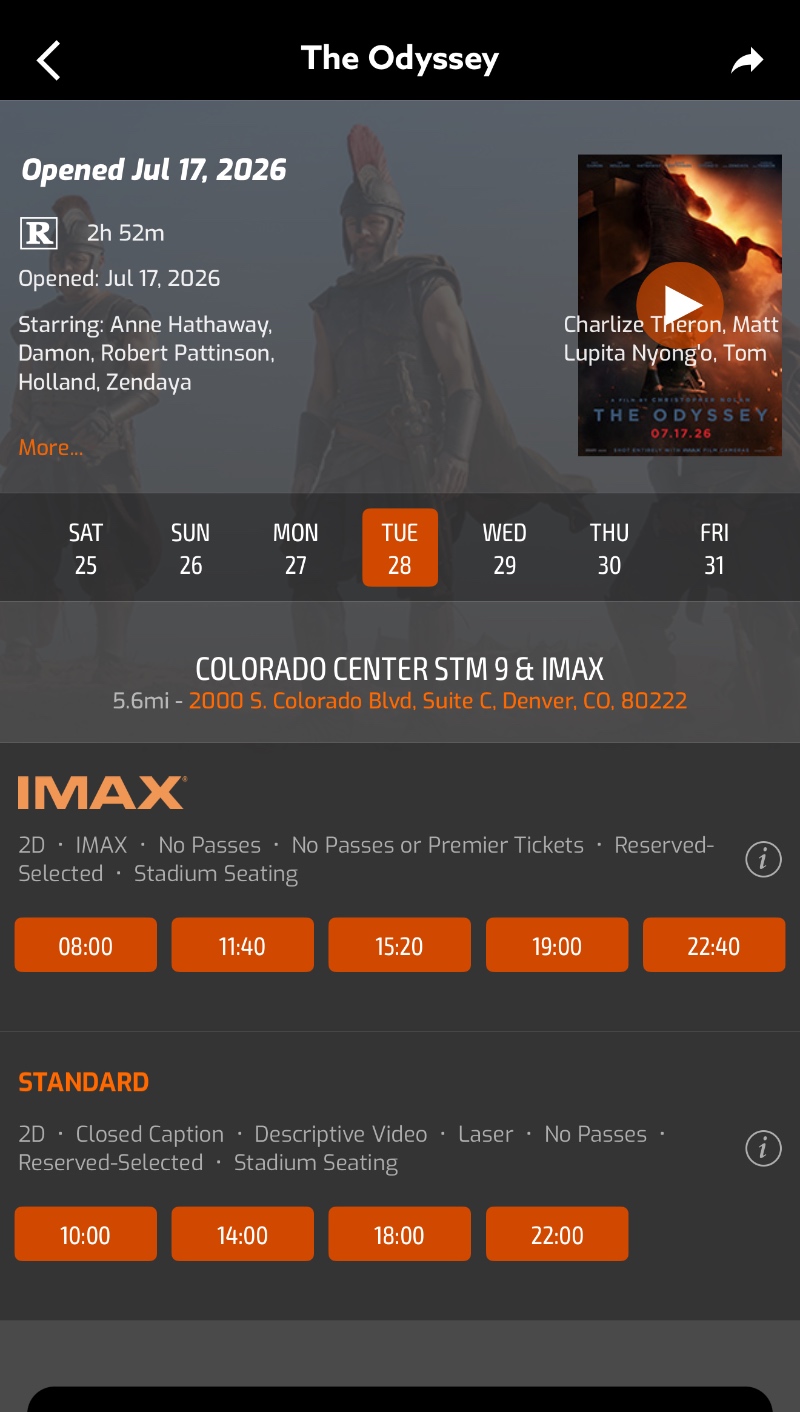 20 July 2026
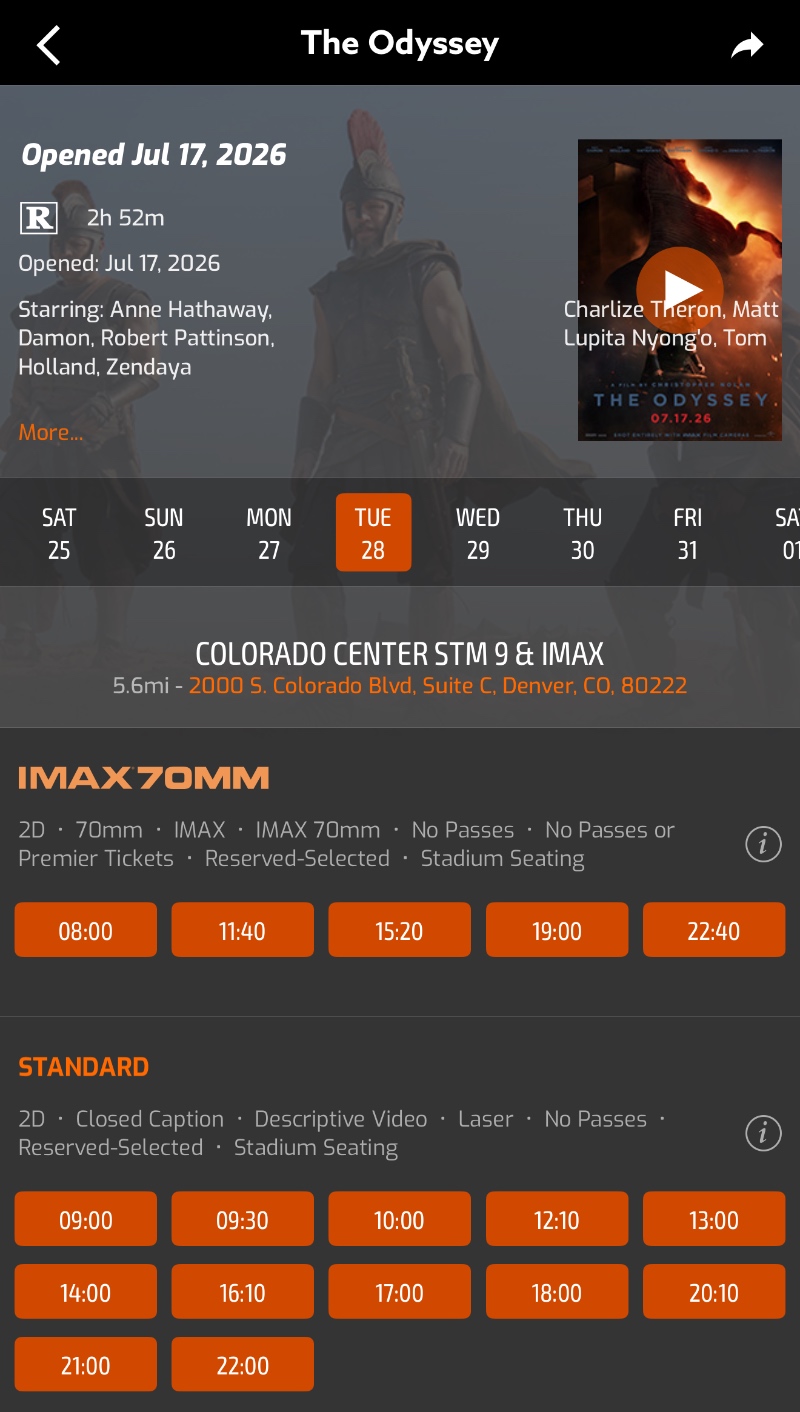 25 July 2026
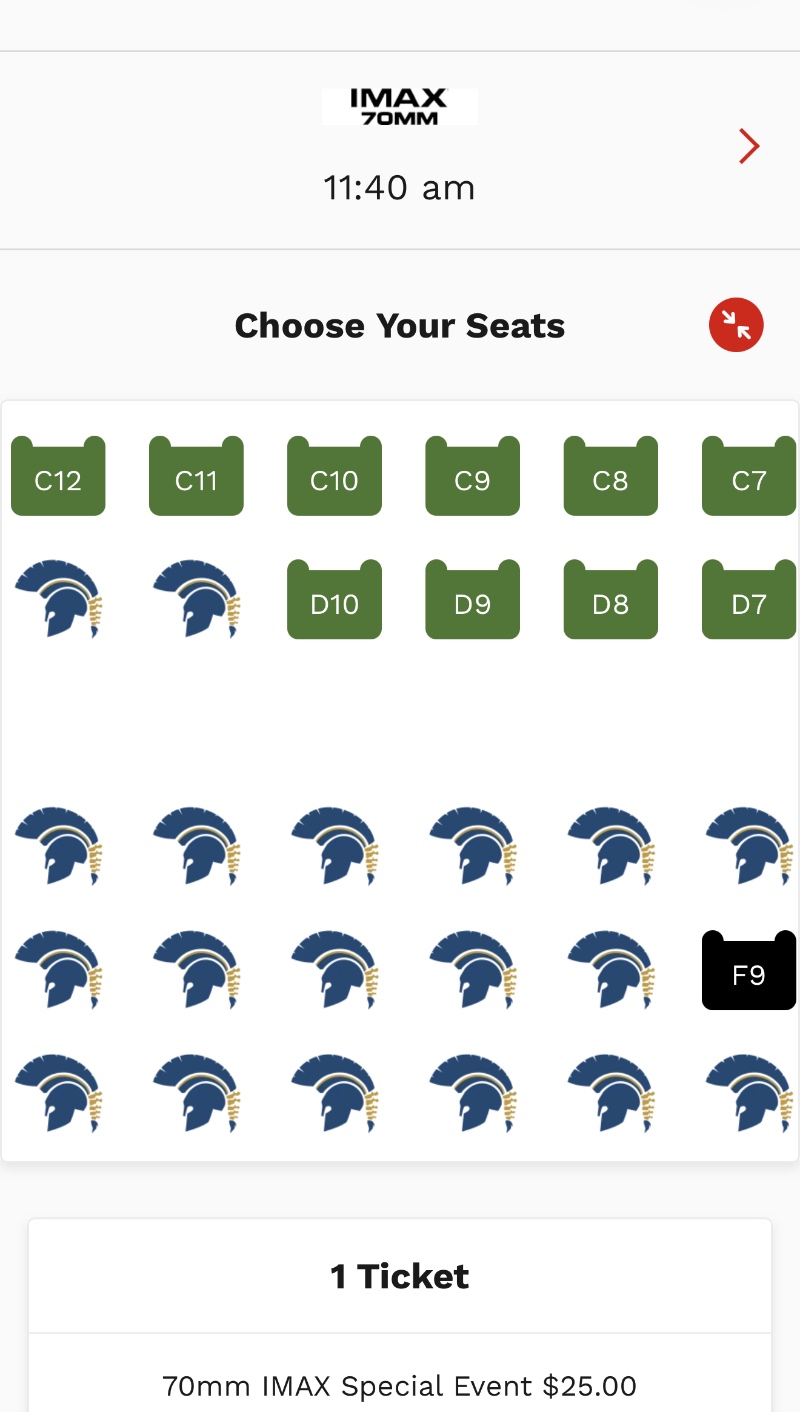 20 July 2026
Briefly, the Regal app showed Odyssey as being in IMAX at Colorado Center with tickets for $22.49 (+ $2.50 online processing fees). Was that to acknowledge the film projector would not be fixed any time soon? Was this a price reduction after opening week? Was it a change to compete with Cinemark Carefree’s lower price ($25 ticket + $2.53 fees and taxes)?
Or none of the above? Was it instead merely a classification boo-boo?
Based on the above screenshots (all three are for 28 July), it was a mistake. The app now shows it as once again in IMAX 70mm and the price is back to $31.99 (plus that irksome $2.50 processing fee). It’s so cool to see the alternate formats have also tripled the number of showings.
Cinemark gets bonus points for using a classic Greek helmet to indicate seats that have been purchased, as shown in the third screen, zoomed-in on the seat selector.
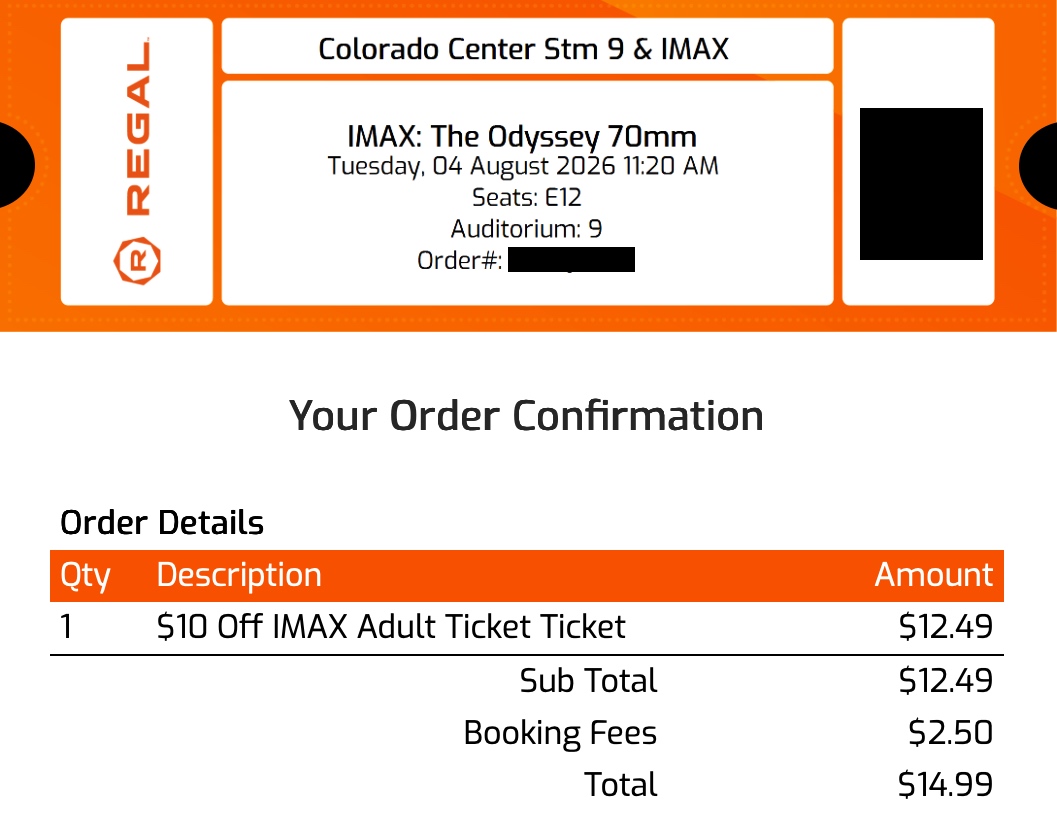
The $10 discount in the above screen is from a Regal offer providing $10 off an IMAX ticket after seeing three (different) IMAX movies.
Take IV: 28 July 2026, 11:40, Cinemark Carefree IMAX 70mm Film, Colorado Springs • F9
I’ve noted in the past how Nolan’s themes tend to run conservative, but I held off on this one given all the juicy nonsense being thrown around from all sides. The Odyssey is the ultimate finger-pointing movie. As in, wing-nuts on the right and wing-nuts on the left can claim ideological alliance with its themes.
But the last line – spoken by Odysseus in a voiceover while Troy burns – is so powerful.
“A new dawn will break over the darkened world and our mistakes will once again be forgotten.”
Here’s the problem: students aren’t learning history and a considerable portion of what is being taught is revisionist and driven by a political agenda.
People should push back on morons (like Hasan Piker) who dress like Mao Tse-Tung and proclaim him as one of the greatest men of the 20th century. He was horrible. And I dare say the number of people in China pining for the “good ol’ days” of Chairman Mao and his Little Red Book are “near zero,” to repurpose an impactful phrase from Nolan’s Oppenheimer. Freedom of speech is one thing, freedom of ignorance is something else.
Unrelated to this is Emily Wilson’s review of Nolan’s movie. She hated it and basically said she’d be embarrassed to write something like that. And yet the irony that this coverage is missing is right there: while many praise her translations of Odyssey and Iliad, when Nolan offered his praises of Wilson’s work and held it as a source of inspiration, many were quick to point out her approach to the translation and tempo left out much of the nuance, significantly reducing Homer’s work. Even so, Wilson’s comments resurrected a recurring question I’ve pondered from time to time: how do some people watch movies? Typically I ask this after encountering a totally contrarian view, often counter to my own.
As it stands, I went with Stephen Fry’s modern overhaul (so modern, it includes pop culture references to Harry Potter and other popular works inspired by Homer) and the more academic translation by Daniel Mendelsohn. I did run with Wilson’s Iliad, even over the work of a personal favorite author, Caroline Alexander. A lot of it is all about preference.
A lot of it is also about pulling out themes and making an experience that rings true with modern audiences. Then there are the “historical accuracy” rock throwers who decry the use of “Dad,” “Mom” and a couple “F”-bombs while ignoring how nobody would even be speaking a word of English in a truly “accurate” telling, which would most likely be unwatchable on many levels. As an unaffiliated voter, the jousting is entertaining, but the flagrant display of ignorance from “both” sides is so embarrassing.
One other thought for Take IV and it’s a bit of a heartbreaker: for many years I’ve revered the Colorado Center as my favorite theatre in the greater metro Denver area. But Cinemark Carefree was even better. I estimate the screen to be 3-6 feet shorter than at Colorado Center, but the 70mm film presentaton was gorgeous. Much brighter (going back to my original hypothesis Colorado Center is intentionally keeping the bulb dimmed). The sound might not be quite as loud (I love the immersion of the louder presentations, while many whine about it). But a terrific amount of detail became apparent at the Cinemark, most notably the teeth on the Scylla’s six heads.
As a bonus, human beings came out to introduce the movie and explain its significance. The young employees were clearly excited about the film presentation. They unspooled 24 frames from Mars Needs Moms (cheekily commenting the studio doesn’t want that movie back). They also shared how Odyssey is playing in six different formats, but this IMAX 70mm film version is Nolan’s preference. I also appreciated how they called out the prior limitations of filming with IMAX cameras because of their noise, something I was discussing with the really nice folks sitting next to me in the packed house – on a Tuesday afternoon.
The reception has been phenomenal, obviously, with the movie’s staggering box office performance. And, contrary to Wilson’s view, people were searching for new superlatives to describe the experience.
It’s also terrific to get updates from the TCL Chinese theatre in Hollywood announcing additional showtimes.
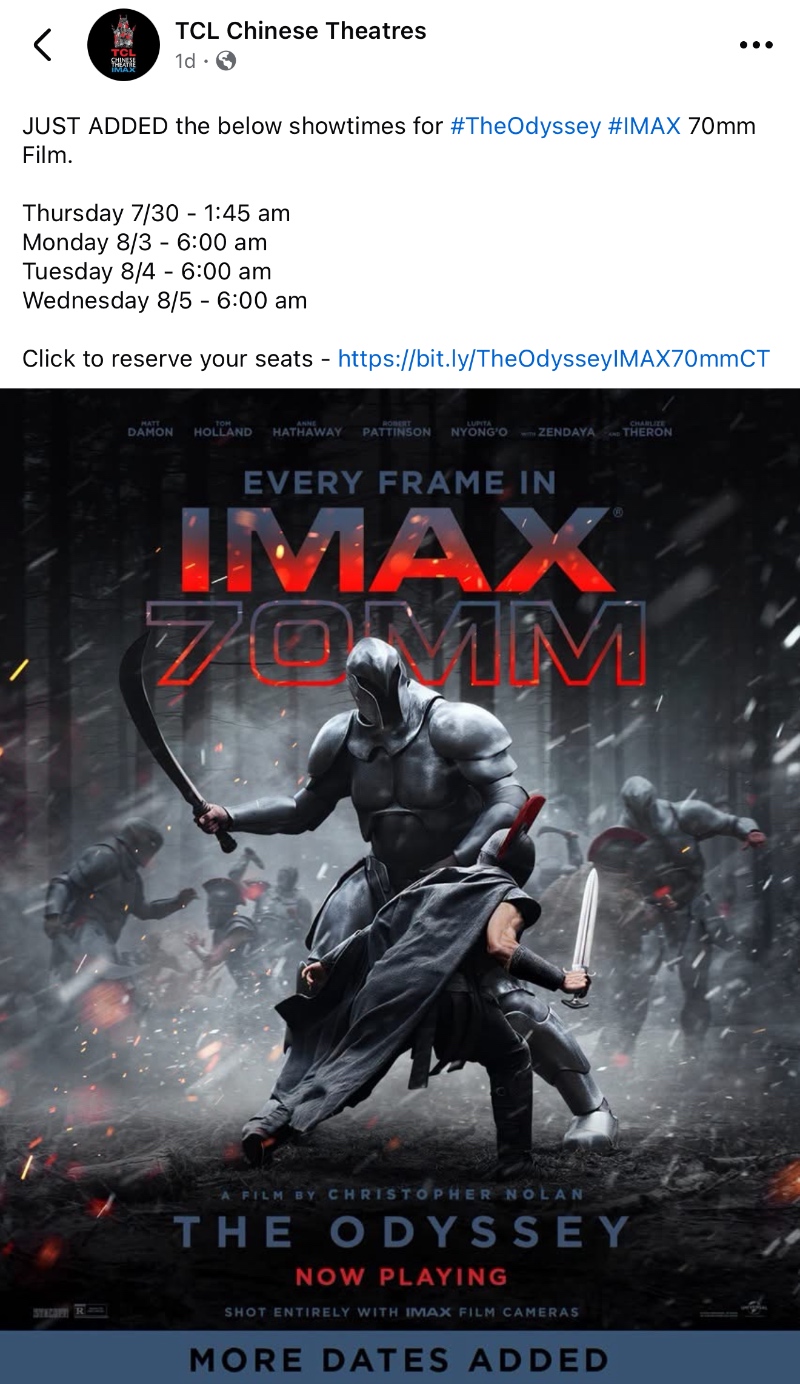 28 July 2026
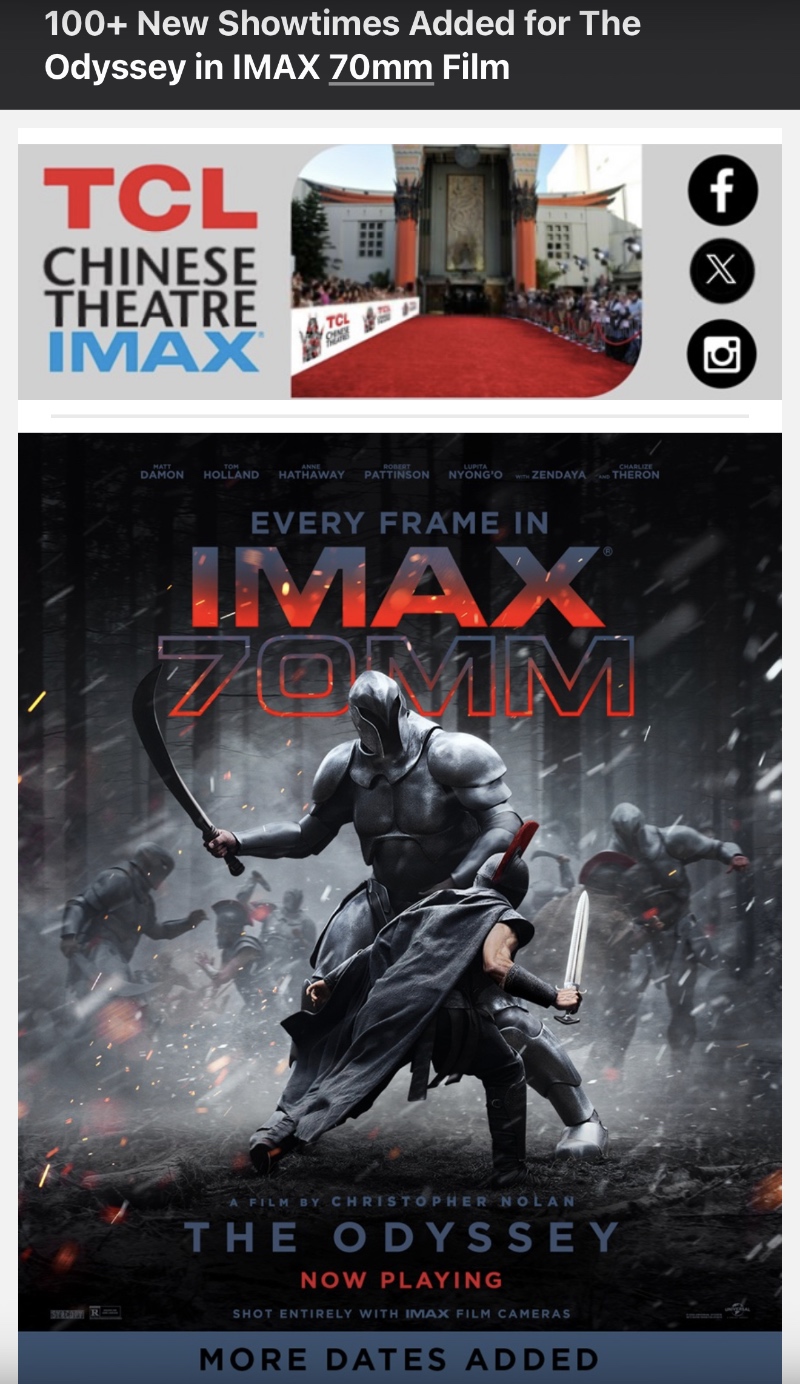 30 July 2026
Colorado Center IMAX 70mm Film Update: 30 July 2026
So, I “had” to swing by the Colorado Center for the 12:00 noon first showing of Spider-Man: Brand New Day. Yeah, I attended the press screening earlier in the week, but I wanted to give it a second go before polishing off my review. Same reaction as the first time, more crystallized.
As it happens, they were once again offering refunds or vouchers for Odyssey in IMAX 70mm film. The projector broke at the 19:00 show last night, so it’s been up and down since the movie opened. Apparently IMAX express delivered some parts, but they didn’t fix the issue.
Still, the crowds and the enthusiasm are so, so, so great to see.
And the horse popcorn container is sold out. (But, more camera buckets are available at IMAX.com in what is at least its third run. They ship in November.)
Compound that with Spidey’s opening, and the place is jumping like a brand new heyday. The surface lot is full and, since Odyssey opened, the parking garage gates have been up to support the crowds and in quite a contrarian surprise, provides free parking!
This is the way it used to be. Excitement about the theatrical experience and excitement about a movie that generates conversation and – holy heck! – stimulates THOUGHT! This Odyssey is so historic for so many wonderful reasons.
Take V: 4 August 2026, 11:20, Regal Colorado Center IMAX 70mm Film, Denver • E12
The IMAX film projector is up and running again. They told me it’s been running smoothly since Friday.
Sorry, Cinemark Carefree, but I have to confess my heart belongs to the Regal Colorado Center. I have enjoyed our fling. Deeply. And there’s room for both of you in my life.
I can’t say for certain if any changes were made during the repairs, but the picture seemed brighter this time. And I prefer the extra screen footage of what I attest is a slightly larger IMAX screen at the Colorado Center.
Regardless, it keeps striking me and I keep failing to mention outright how cool the gods are employed in the movie. It’s the thunder. The lightning. The wind. The rain. The massive storms at sea. That’s the work of those Olympian gods, left as a mysterious force unseen rather than a character potentially illuminated like a deceased Jedi knight. But, yeah, even the beggar at the feat at the movie’s beginning kids with Telemachus about how “lucky” he was to Zeus’ thunder roar right as he honored Zeus’ law in defiance of Antinous and the Bard.
Take VI: 5 August 2026, 15:00, Regal Colorado Center IMAX 70mm Film, Denver • I3
After six viewings, I have to say this one’s becoming the “ultimate” movie for me. I’m used to the eyebrow raising. The five Indiana Jones movies (yes, all five) are my go-to cinematic comfort food, regardless of all the people who hate Crystal Skull and Dial of Destiny. I could not conceivably care less. And I mention them only because they are favorites for a personal reason: they are the movies I relate to more than any others. Laugh at me. I don’t care.
And that relatability keeps punching at me with Odyssey. I wouldn’t go back to a 3-hour movie time and again if I wasn’t getting something out of the experience.
The past two years in particular have been personally transformative. Social changes. Job changes. An opportunity with the FDA gained and lost (within one week). Pneumonia. Long-standing unresolved conflicts revisited. A SCUBA certification detour. Peace at the River Kwai.
Scoff if you want, but it has been a personal odyssey. One that ramped up with a New Year’s Eve river cruise on the Mekong. I’ve never felt such mystical forces before, forces – spirits – seemingly guiding me into a different direction. It’s been a remarkable time.
And Odyssey is a remarkable movie for its numerous messages about civilization as well as its masterful technical filmmaking. Nolan’s movies invite repeat viewings, dissection and discussion like no others.
By the way, there’s also the fun “movie geek” stuff, too.
During this screening, at one point a thread – a thread! – appeared on the screen and jittered its way down then off the screen. Its part of the organic, tactile experience that is film. Along with the wear and tear that presents itself through frame scratches and other blemishes. Its not to be feared; it should be revered.
And the IMAX camera popcorn bucket is once again sold out on IMAX.com.
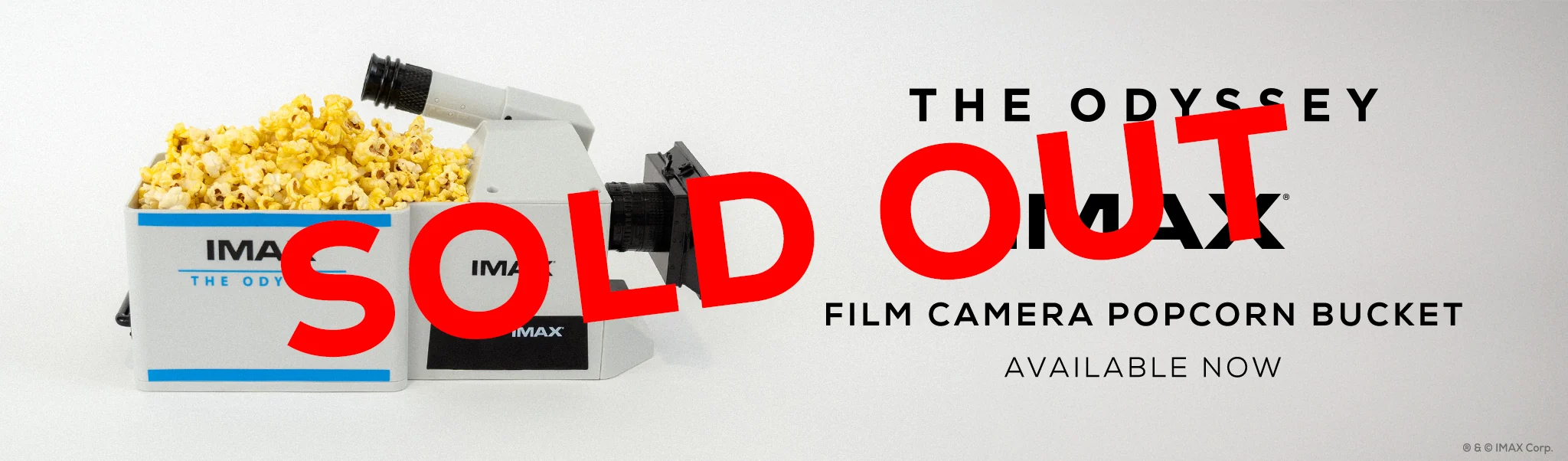 The sold-out IMAX camera popcorn bucket.
Image courtesy of IMAX Corp.
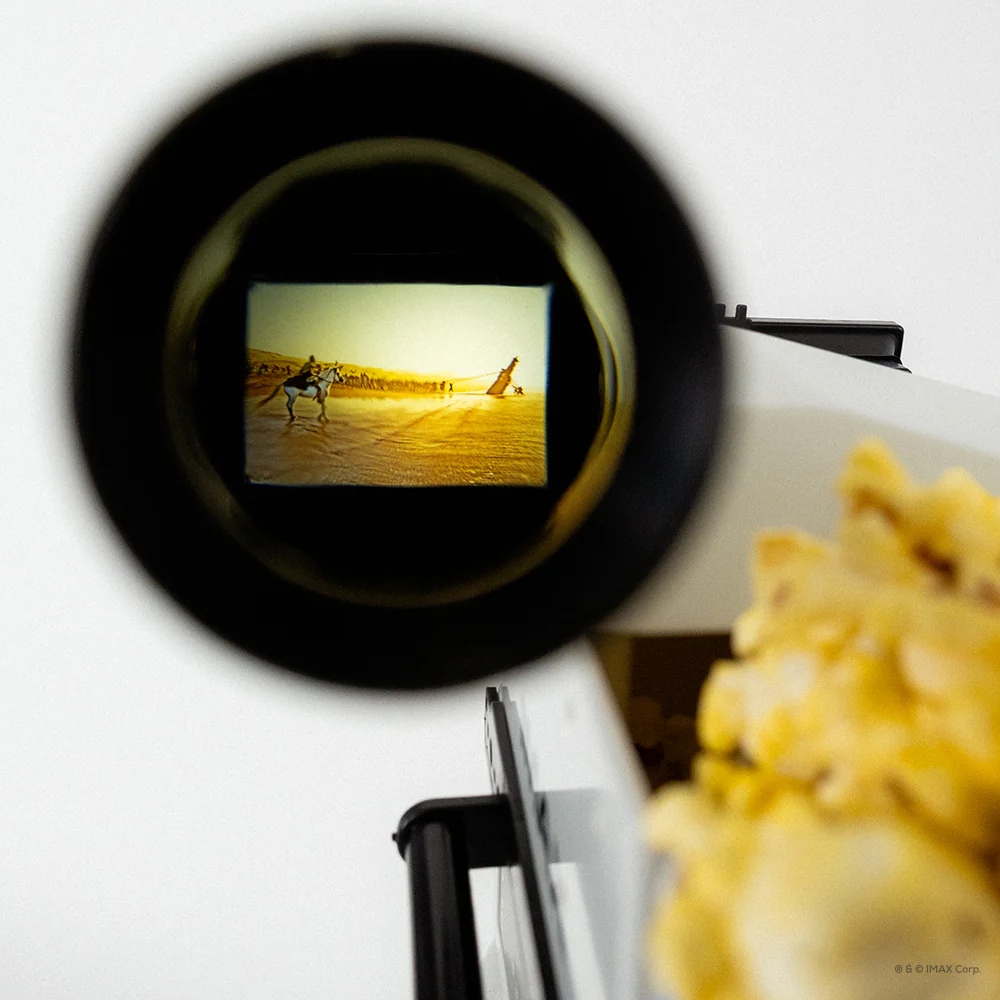 Part of the charm of the IMAX camera popcorn bucket is it features a “working” viewfinder. It lights up to display a frame from the movie.
Image courtesy of IMAX Corp.
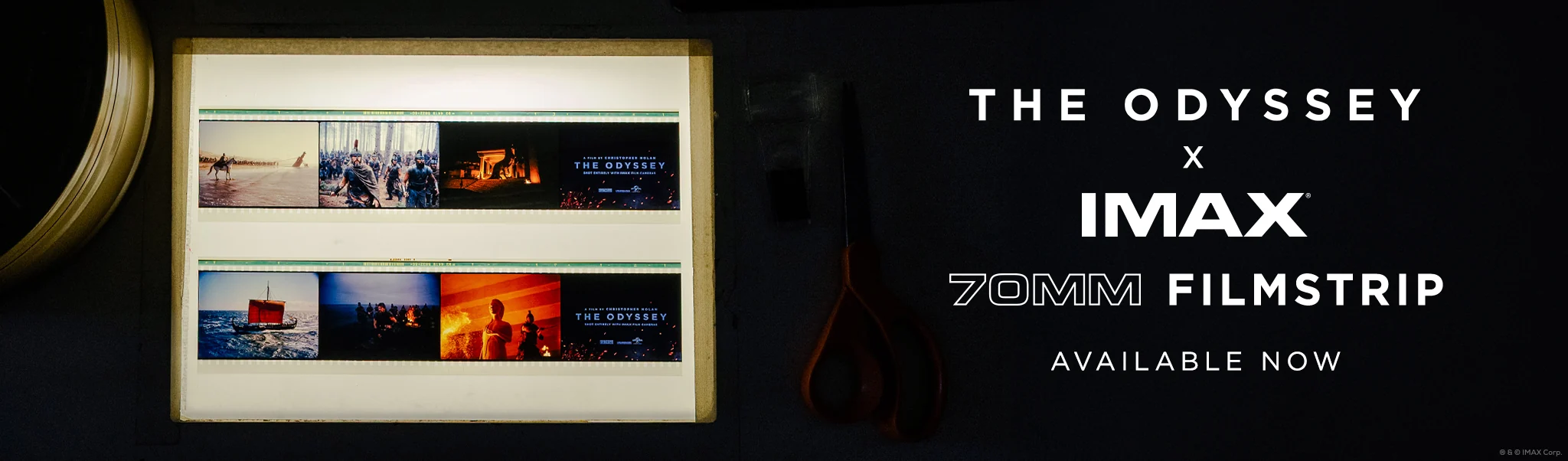 There isn’t much in terms of merchandising for this one. But, following the lead of Oppenheimer and Project Hail Mary, IMAX released filmstrips in the online store. Similar filmstrips were available at some theatres (not Denver).
Image courtesy of IMAX Corp.
Take VII: 11 August 2026, 11:40, Cinemark Carefree IMAX 70mm Film, Colorado Springs • G15
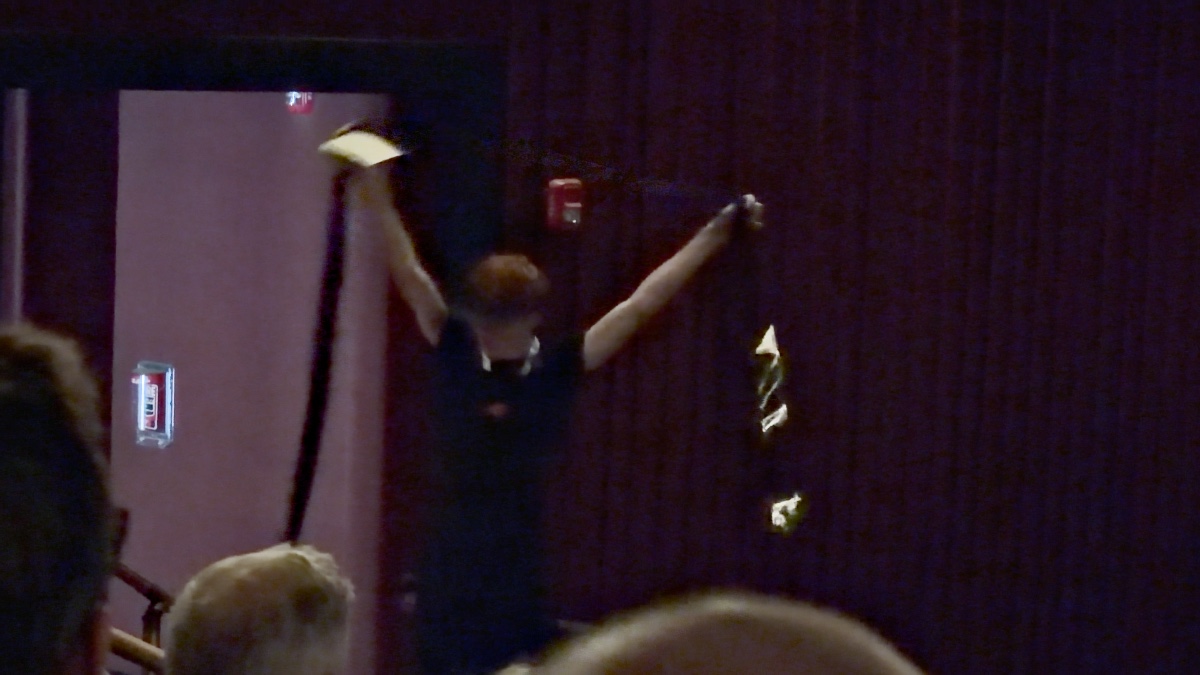 A screening attendant wrangles 24 frames of IMAX film from (allegedly) Mars Needs Moms.
They’re still doing the human introduction. This time, there was only one usher (or is it screen attendant now?). Good kid, single-handedly wrangled the 24 frames of film. Fun facts: at 24 frames/second, that equates to 247,680 frames. And, as he pointed out, that’s the equivalent of 11 miles of film. (Nolan shot 2.1 million feet of IMAX film during its production.) And those IMAX cameras film at the equivalent of an 18K resolution.
He also introduced this performance’s projectionist up in the booth, Anna. We all applauded and waved.
C’mon. This is so special.
I still think the picture is brighter at Carefree compared to Colorado Center. But I also think the screen is shorter.
Take VIII: 18 August 2026, 08:00, Regal Colorado Center IMAX 70mm Film, Denver • F19
It was quite the odyssey getting to this early morning screening. Evans was jacked up with construction and heavy traffic. Had to resort to back roads and alternate routes to the alternate routes, plopping my bottom into my seat only moments before the movie started.
Da-amn. I love this movie!
Intermission: 22 August 2026, Chasing the Escaping Sun – Curaçao
 The “replica” Athena pin from Noble Collection is only 2.5 inches tall. Here, it’s set against the escaping sun in the Pietermaai district of Willemstad, Curaçao. Shot with the iPhone 17 Pro Max.
The Odyssey at 08:00. Then a flight to the ABC Islands in the Dutch Caribbean at 23:59. Time for adventure – including SCUBA – in Aruba, Curaçao and Bonaire.
Take IX: 3 September 2026, 18:00, TCL Chinese Theatre IMAX 70mm Film, Hollywood • R411
It’s interesting how the IMAX 70mm film presentation fineries vary from venue to venue.
At the famed TCL Chinese Theatre on Hollywood Boulevard, it’s not an IMAX-shaped sreen. It is a “multi-purpose” venue in that regard.
The seating is farther back from the screen, with a large staging area gap on the floor in front of the screen. The curtain pulls back to a shape “roughly” 1.43:1 thanks to pillar boxing.
Unlike the Colorado Center and Carefree, which show only the special IMAX 70mm film preview of Dune: Part Three, TCL has managed to include a few other trailers. (And people arrived late since they’ve been “trained” to come in after the trailers have started, after the audiorium’s gone dark and, as a result, wind up stumbling over people while trying to find their seats. Stupid.
Other Mommy looks interesting. Street Fighter not so much. There were also The Hunger Games: Sunrise on the Reaping and Resident Evil. They’re on my “must-see” list.
The problem is, the trailers look warped, as if they were converted using some sort of telecine adapter. The image curved inward pretty sharply, making for an ugly presentation. It was semi-oval instead of rectangular. Even Dune: Part Three curved in toward the top of the screen.
The initial impression was one of incredible disappointment for such an A-list venue.
Then Odyssey begins and almost all of the warping goes away,
Phew.
Even better: as the movie plays out, I’m struck by how sharp and bright the image is. I start to question if it’s actually digital. I don’t see any of the normal tell-tale organic blemishes, the random hair floating past the lens.
But then there are a couple scratches. So it must be film, but it’s a superlative presentation. The image is so sharp. The details are so rich. The weave of Odysseus’ robe and other facets of the production are immaculate in the scale and the detail.
The big question is why there isn’t a more predictable consistency among the 41 IMAX 70mm screens.
Also, it was an impresive crowd, even more so considering the movie's been playing for almost seven weeks at almost all hours.
I’ve seen quite a few movies there and the only time I can recall a larger crowd was at Mad Max: Fury Road during its opening weekend. (Great crowd.)
Typical of the best audiences, the crowd cheered when Odysseus kills off the Bard and Antinous. We also applauded at the movie’s end title.
Take X: 7 September 2026, 07:00, TCL Chinese Theatre IMAX 70mm Film, Hollywood • M413
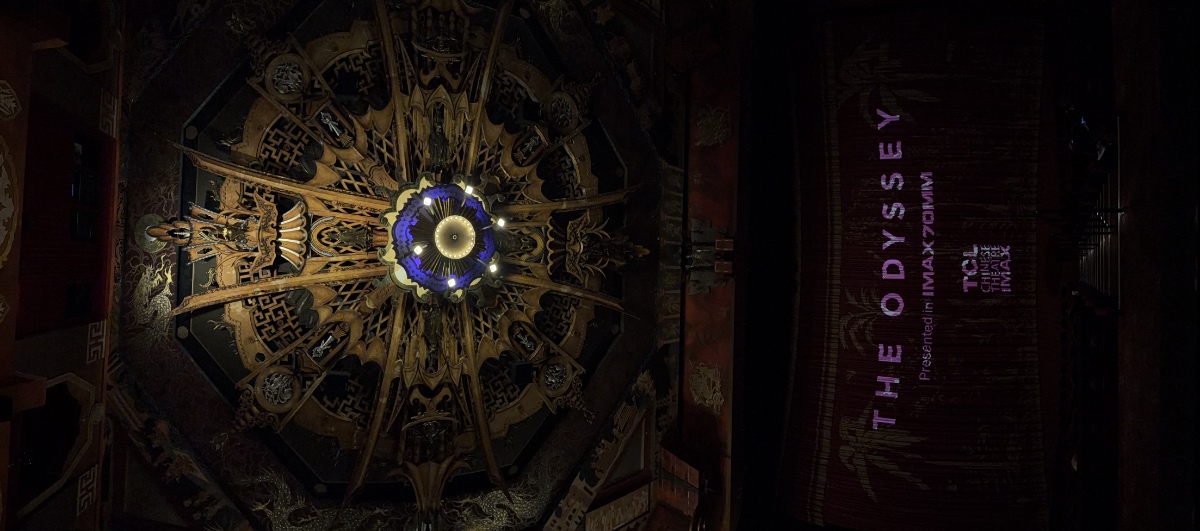 A panoramic view, from ornate ceiling to curtained screen. Shot with the iPhone 17 Pro Max.
Cool. My Waymo ride dropped me off directly in front of the theatre. It’s early. Hollywood Boulevard is still pretty quiet. All the vendors and tourists have yet to arrive.
It’s undeniable. Nolan has nailed the story beats. And so has Göransson with his remarkable score.
And kudos to the TCL Chinese for adding to the atmosphere by playing the movie’s screen, set against a nice title and venue card displaying on the curtained screen. This is an event movie of a magnitude that hasn’t been seen in ages.
Take XI: Final Show of Run – 30 September 2026, 19:00, Regal Colorado Center IMAX 70mm Film, Denver • E13
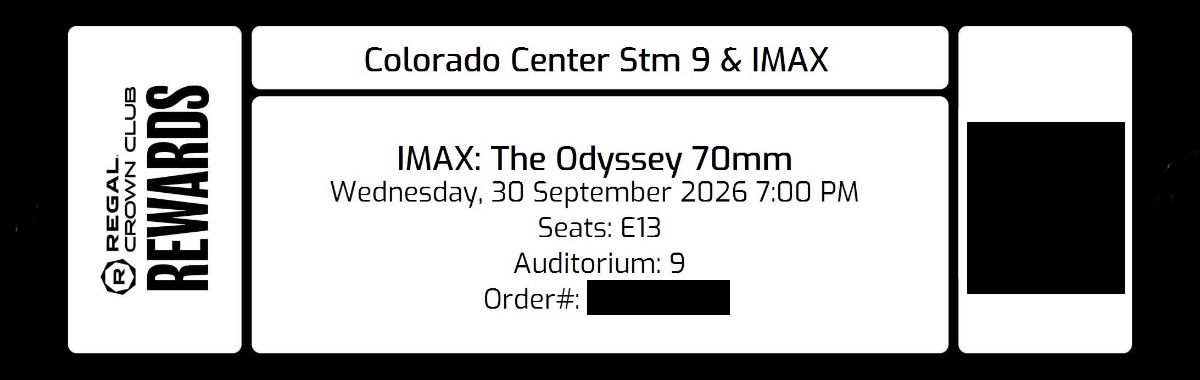
Wow! It’s a near sell-out for the final show of the IMAX 70mm run. What an incredible 11 weeks.
The crowd was still piling in at 19:07. As a courtesy, the show started at 19:18.
Digger opens tomorrow, 1 October, in the IMAX auditorium. Plenty of seats available – and at a discount, too.
The Colorado Center presentation is my favorite of the three experiences. And I’m now hooked on row E.
Epilogue: 5 October 2026
The party’s over.
The Colorado Center parking garage is gated agin. It was open – free – at all hours during The Odyssey run’s enormous crowds.
Went to see Digger in IMAX. Only seven people in the whole auditorium.
It’s akin to the restless disappointment of life’s realities after a U2 tour.
Defy the Gods: 7 October 2026
The party’s not over.
I figured something was afoot (and amiss) when I got this email from IMAX.
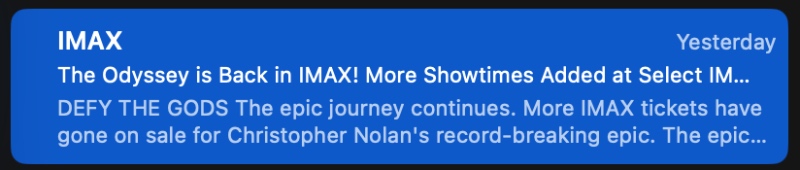
The email summary sure was exciting.
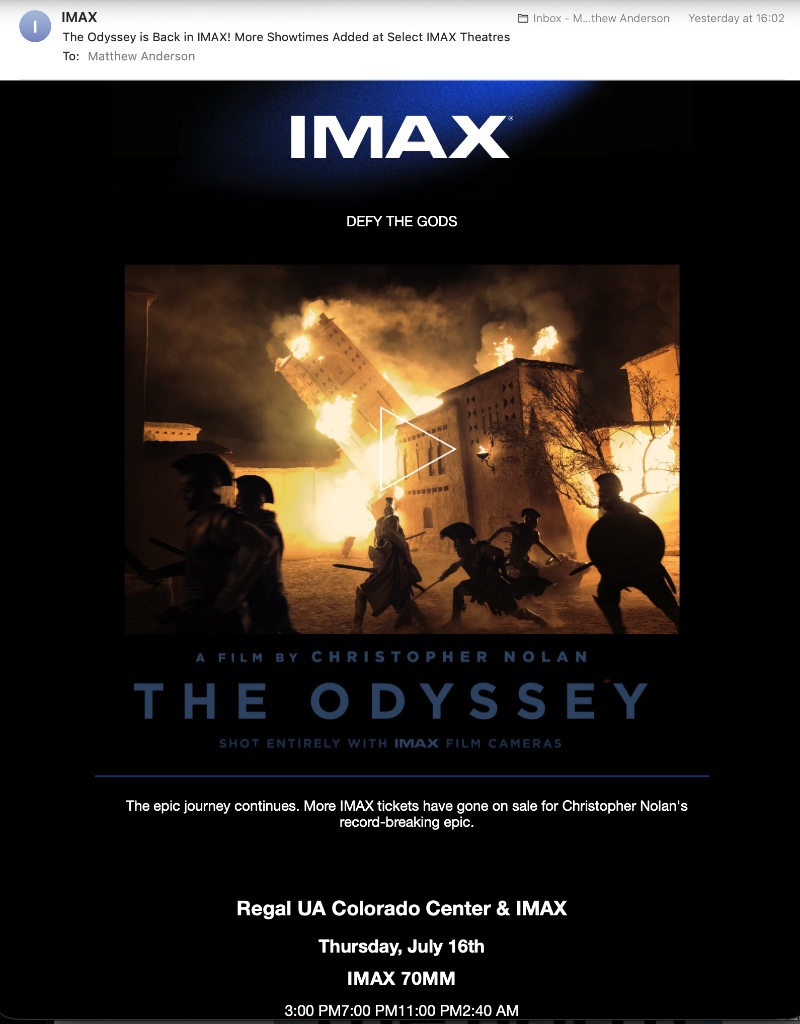
But seeing the body text, which showed the original release’s showtimes, left me wondering if it was a boo-boo made by an over-anxious intern excited to get the news out there.
Thankfully, The Odyssey is returning to the Colorado Center in IMAX 70mm film for a brief run to shore up the unexpected void left by Digger leading up to Street Fighter next Thursday.
Take XII: 11 October 2026, 19:40, Regal Colorado Center IMAX 70mm Film, Denver • E18
Absolutely incredible!
Given Odyssey returned to IMAX 70mm film this weekend in the wake of Digger’s misfortune, I grabbed a ticket since it seemed like the right thing to do. An encore performance.
It was short notice for theatres to announce the return. Nonetheless, 12 weeks into its run – and on a Sunday evening – the show was still packed. A solid 80-90% capacity.
Simply stunning turn out. Most new IMAX releases don’t draw that kind of crowd.
But it’s worth it. Spectacular sound. And I think they brightened the projector lamp a bit. I also appreciate how – throughout this run – the auditorium doors have been closed by theatre staff once the show starts. It’s a pet peeve of mine to have the lobby lights (and sometimes even obnoxious noise) creep in when the doors are open, which has been typical for most shows. Unless, of course, I preemptively closed the doors myself.
• Initial review also published at MovieHabit.com.
Directed by Christopher Nolan
- Batman Begins
- Batman Begins (DVD)
- The Dark Knight
- The Dark Knight Prologue
- The Dark Knight Rises
- Dunkirk
- Following
- Inception
- Insomnia
- Interstellar
- Memento
- The Odyssey
- Oppenheimer
- The Prestige
- The Prestige (DVD)
- Tenet
Behind the Scenes

Contact 
Write Matt
Visit the Speakers Corner
Subscribe to Mattopia Times
Support 
Help Matt live like a rock star. Support MATTAID.
It's a crazy world and it's only getting crazier. Support human rights.
Search 
The Mattsonian Archives house more than 1,800 pages and 1.6 million words. Start digging.