Movies

New Releases • A-D • E-H • I-P • Q-Z • Articles • Festivals • Interviews • Dark Knight • Indiana Jones • John Wick • MCU
Go behind the scenes of
Project Hail Mary with Ryan Gosling and directors Phil Lord and Christopher Miller
Featurette: Amazon MGM Studios
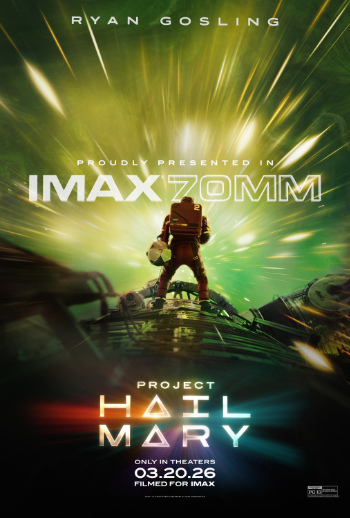
Project Hail Mary
Directed by Phil Lord and Christopher Miller
Rated PG-13
Rescued 20 March 2026
#ProjectHailMary
Project Hail Mary orbits greatness.
Rising Stars
Given the state of Hollywood and its current prevailing, insidious view of movies as merely “content,” it’s refreshing when a big-budget movie comes along featuring an array of smart characters and an interesting story of hope for all mankind.
Project Hail Mary is an adaptation of Andy Weir’s novel, working with a screenplay by Drew Goddard, who also adapted Weir’s The Martian for Ridley Scott. The famed directors of Project Hail Mary, Phil Lord and Christopher Miller, made all the wrong headlines with their Lucasfilm dustup over Solo: A Star Wars Story, which was largely reshot by Ron Howard before fizzling at the box office and stifling the saga’s cinematic fortunes for years. But they’ve found more than enough redemption as producers and writers of the acclaimed Spider-Verse animated features. (Years ago, the duo set to work on an adaptation of Weir’s Artemis, which is still in development.)
All that said, this is something of a moonshot for its studio, Amazon MGM, which put up a budget somewhere in the vicinity of $200-$250 million, easily making it the online giant’s biggest theatrical production to date. Oddly enough, Amazon is so big and so keen on that “content” for Prime Video, they’re perhaps less concerned about its box office prospects than most studios would be.
Thankfully, they got their money’s worth creatively, with the financial rewards still to be unlocked. Project Hail Mary is an impressive technical feat that benefits from its IMAX presentation. It truly deserves to be seen on the biggest screen available (hint: it’s larger than the typical living room – or man cave – wall). There’s a conceit to the format: all the scenes in outer space (which Miller estimates as 75% of the movie) are in the extra-large frame format while all the scenes on Earth are in scope (2.39:1). Scenes of transition between the narrative’s timelines – memories from back on Earth, for instance – are buffered by visual effects that bridge between the two aspect ratios.
Interstellar Challenges
Project Hail Mary revolves around Ryland Grace (Ryan Gosling, who’s a new hope for Star Wars as the star of Starfighter next year), a popular middle-school science teacher who – refreshingly – cuts against the grain and refuses to back down from his (unpopular) views of how things work. He certainly caught plenty of heat and lost friends for deriding a fellow scientist as “a staggering waste of carbon.”
Nonetheless, Ryland hits the radar of NASA and other scientists from around the world for his studies of the Petrova Line and something called Astrophage, essentially a parasite eating away at the sun.
The bottom line: there’s a big problem looming and Ryland’s research is seen as a last hope to solve a major crisis: given some observed curious spatial activity, it’s anticipated Earth will cool by 10-15 degrees in the coming decades, causing a global economic collapse and global food shortage.
Put more simply: Earth’s sun is dying, which, in the parlance of Ryland’s school kids, is a “big whoop.”
Maybe this scruffy, bespectacled teacher can help.
And that’s where Project Hail Mary also finds its key themes: there’s a collective of scientists from around the world working together (imagine that) to solve a major existential crisis and there’s also the story of this teacher who questions his own abilities and worth, with each challenge thrown at him proving to be its own gateway to growth.
Hope. Persistence. Ambition. Collaboration. Loyalty. Character. All solid traits that are typically too hard to find. Perhaps in this case it’s dreamwork that makes the team work.
Gosling is great as that teacher who’s drafted by Dutch scientist Eva Stratt (Sandra Häller) for a perilous space mission. His tale isn’t simple and the narrative structure is pretty clever. It establishes his character as a bit of a goof (think “The Dude in Space”) in the beginning and as the main plot moves forward to solve his being stranded solo in outer space, his back story – his memories – flow in parallel. The result is a terrific conclusion that reaches the narrative climax at the same time the flashbacks reveal Ryland joining the crew wholly against his will.
Close Encounters
While Weir’s father was a physicist, his own career was going down the world of code as a video game programmer. Perhaps the world should be thankful that line of work didn’t pan out and Weir instead became a writer of science fiction informed by loads of research. And this is indeed a whole lot of science fiction with a healthy sense of adventure.
The challenges are impressive. Ryland is the sole survivor of a crew of three; the pilot and engineer died in a system failure en route to their destination. From the get-go, there was no expectation Ryland would ever return to Earth and life as he knew it. Communications take 11 years to reach Earth. It’d take roughly 113 years for him to return home with the available resources.
As it happens, another planet is anticipating a horrible fate like Earth and a crew of 24 was sent from Erid to perform work similar to Ryland’s. This is where narrative shorthand is required to make it all work. The Eridians are stone-like and spider-like creatures; they don’t have recognizable characteristics like a face. And yet, in cinematic short order, Ryland and the sole survivor of the Erid spaceship – nicknamed Rocky (and with a wink to Sylvester Stallone’s Italian Stallion) – learn how to communicate with each other. Ryland oh so quickly and easily builds an English voice bot (voiced by James Ortiz) to make the comms all that much smoother. (And, of course, to make the movie watchable.)
While the two tackle the scientific issues at hand (including the discovery of a counter parasite that could eradicate the Astrophage), they also form an unlikely bond. The amazing thing is it really works and the heart strings are pulled in nearly tear-jerking directions rarely experienced since E.T.: The Extra-Terrestrial.
But, as one discovery is made, a new setback is encountered. This leads to the story bumping up against multiple false summits that become a little tedious. Even so, Weir (serving here as a producer) and his movie adapters finally land on an ending that “feels right.”
Tech Specs
At 156 minutes, Project Hail Mary runs long, but it still plays well because it’s one of those increasingly rare movies that fascinates purely on the technical level of its production and execution.
There’s a graininess that makes it look like film, but that’s movie trickery. Cinematographer Greig Fraser used digital cameras and the same “film out” process he used on Dune and The Batman to give it that vibe.
Many of the visual effects also appear more tactile than digital. Indeed, there’s a mix of practical (on-set) effects thanks to puppetry along with the modern standard of pixelated magic, with the curious absence of the ol’ green (or blue) screen. It’s a solid creative and technical move that further sets this project apart from others of its genre. An old-school movie vibe permeates Project Hail Mary, making it feel at home alongside classic sci-fi from the 1960s-1980s, including movies like Alien, Close Encounters of the Third Kind, 2001: A Space Odyssey and E.T.
Lord and Miller have fun with the vibe and the pop culture references, including the Alien chest-burster and those goosebump-inducing five notes from Close Encounters.
• Originally published at MovieHabit.com.
Contact 
Write Matt
Visit the Speakers Corner
Subscribe to Mattopia Times
Support 
Help Matt live like a rock star. Support MATTAID.
It's a crazy world and it's only getting crazier. Support human rights.
Search 
The Mattsonian Archives house more than 1,800 pages and 1.6 million words. Start digging.