Movies

New Releases • A-D • E-H • I-P • Q-Z • Articles • Festivals • Interviews • Dark Knight • Indiana Jones • John Wick • MCU
Pressure, starring Brendan Fraser and Andrew Scott and directed by Anthony Maras
Trailer: Focus Features
Pressure
Directed by Anthony Maras
Rated PG-13
Invaded 29 May 2026
#PressureMovie
Pressure tells a crucial, yet little known and underappreciated World War II story.
One Mistake
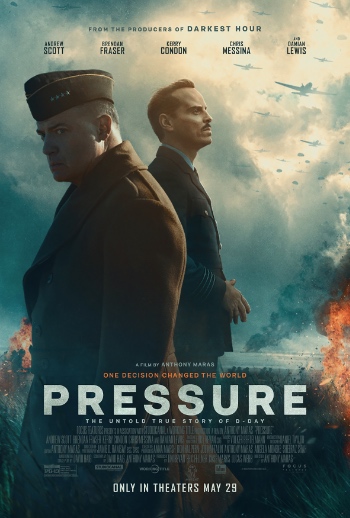
Given it’s based on a very real, very true World War II event, Pressure comes as a pleasant surprise as a movie that’s being released in the thick of a surging summer movie season. As a strategic move in counterprogramming, it’ll have its work cut out for it, but it’s most certainly a worthy movie. Attention must be paid.
It all starts with the title. It’s brilliant in its deceptive simplicity.
Pressure.
At first blush, it’s an obvious reference to General Dwight D. Eisenhower and all the challenges he faced during World War II, some eight years before he’d become the 34th United States president. There are the Nazis, of course. Allies versus Axis. And there’s a call to be made: Do we invade the beaches of France on Monday, June 5? Go? No go? Thousands of lives are at stake.
That’s pressure.
There’s also the conflict between two men – Scottish Group Captain James Stagg and American Colonel Irving Krick – charged with determining that go/no-go call. The fact they have polar-opposite views is only one of their hurdles.
That’s pressure.
For Stagg, his world inside the military is a hot mess. But, as hard as it might be to imagine, it’s even worse on the homefront. His pregnant wife is in a hospital that’s just been bombed. All he knows is there are casualties. But the fate of his wife and their baby specifically is a complete unknown.
That’s pressure.
But – regardless – at the core of the movie Pressure are atmospheric pressure and barometric pressure.
All it takes is one bad call, one wrong weather forecast and the war will be lost.
I Like Ike
Consider some of the great movies focused on World War II that have been released in the relatively recent past. James Vanderbilt’s Nuremberg. Christopher Nolan’s Dunkirk and Oppenheimer. Joe Wright’s Darkest Hour. Going further back, there’s David Lean’s Bridge on the River Kwai. And of, course, there are Steven Spielberg’s Schindler’s List and Saving Private Ryan.
In the latter, Spielberg stunningly captured the invasion of Normandy, turning it into a visceral, harrowing experience for moviegoers.
In Pressure, director Anthony Maras leverages some vintage war footage while also staging some stunning new reenactments. Maras is still not a household name, Pressure being only his second feature film. But his first, Hotel Mumbai, is a powerful account of the horrifying 2008 terrorist attack on the Taj Mahal Palace hotel in Mumbai, India.
At the center of Pressure is Eisenhower, popularly called “Ike.” Brendan Fraser at first blush seems like an odd choice to play this particular historical figure, given all the readily available photos of Ike. Fraser doesn’t embody Ike the way Gary Oldman disappeared into Winston Churchill for his Oscar-winning performance in Darkest Hour. But, nonetheless, there is a scene in which Fraser dons a military cap and there’s a fleeting glimpse – a vibe – of Eisenhower. There’s also a terrific scene during a Sunday church service. It starts to rain outside. The thunder is loud. And Ike – by way of Fraser – has a stern look that grows rather angry, as if he’s ready to “clap back” at God’s claps of thunder. Perhaps Fraser is much bulkier than the real Ike, but he brings the sense of physical presence and authority that is required.
Pray for Good Weather
The screenplay for Pressure was co-written by Maras and David Haig, based upon Haig’s original stage play from 2014. It’s rather astonishing how briskly the movie moves given its subject matter, but credit strong (historical) characters and a powerful, decisive moment in time for offering such an uncommon sense of propulsion.
The conflict between Stagg and Krick underscores how far technology has come in such a short amount of time. For those two, it was the hard work of providing definitive weather forecasts with rather archaic technology. This is all pre-satellite. There’s the weather balloon and there’s the telephone to call weather watchers in any given specific area of interest. It falls right in with Ron Howard’s terrific Apollo 13 and the limited technology that both put men in space and struggled to bring them home safely. And it echoes of that great moment in Nolan’s Oppenheimer, the conversation about a “near zero” chance of incinerating Earth.
Stagg is determined to stand his ground on current evidence of an incoming weather disturbance. Krick, however, is comfortable relying on atmospheric charts dating back to 1904 and 1925. After all, he accurately predicted the weather for a filmmaker named David Selznick and a little production he was working on in Atlanta: Gone With the Wind.
Operation Tiger
But it’s 1944 now. Eisenhower is still reeling from the horrors of Operation Tiger, a training exercise that was intended to be a rehearsal for the D-Day invasion of Normandy. It turned disastrous, killing somewhere in the magnitude of 800 allied soldiers.
And that’s where the pressure in Pressure mounts.
The dialogue is great.
For one, Stagg fully acknowledges pretty much no one in the room likes him. He’s disliked more for his professional stance than anything else; he dares to stand firm in the intimidating presence of Ike and other senior officers while offering a contrarian view, one that argues Krick (whom Stagg describes as a “confident moron”) has merely been lucky in using outdated charts built for far more stable weather environments (such as Africa). He also points out the “off years” that Krick conveniently ignores, such as the weather disturbances of 1916.
And. Yeah. The well-being of his pregnant wife is unknown. Stagg has no choice but to “soldier through” and consider an urgent call about his wife’s indeterminant status as irrelevant. Ike falls in line with that one. It’s inconsequential to the fate of the world.
There’s an enlightening conversation between James Stagg (terrifically brought to life by Andrew Scott, Ripley) and Kay Summersby (Kerry Condon, The Last Station), an Irish aide to Eisenhower who – in real life – had a rather controversial and very close relationship with Ike during those high-pressure years of WWII. Kay posits to James that weathermen are all boring. His reply is spot on: Weatherman might be boring, but weather is exciting. It plays a role in so many facets of life, for good and ill. Such a case could not be more pertinent than the one at hand.
With Ike predisposed to favor Krick (Craig Messina, Argo), given his remarkable track record, Stagg is in the unenviable, pressure-packed predicament of having to argue with leading military officials from the United States and England about the weather. And push back on what they want to believe simply because it’s what makes them comfortable. It’s what they “know.” Delaying the invasion until June 18, as Stagg recommends, is an impossibility given all the wheels set in motion and the potential for all those “loose lips” to sink ships during that hiatus.
And yet the lives of 3,000 men and boys are on the line based on this one go/no-go call.
That’s pressure.
And that’s a remarkably important historical situation that’s gone largely overlooked until now. As with last year’s Nuremberg, it’s an important story to tell and one that should be seen by students near and far and other large swathes of the general population that is comfortably ignorant of history. It’s not about what people want to believe. It’s about what people need to know about the sacrifices made for the abundance of freedom experienced by so many today.
• Originally published at MovieHabit.com.
Contact 
Write Matt
Visit the Speakers Corner
Subscribe to Mattopia Times
Support 
Help Matt live like a rock star. Support MATTAID.
It's a crazy world and it's only getting crazier. Support human rights.
Search 
The Mattsonian Archives house more than 1,800 pages and 1.6 million words. Start digging.