Movies

New Releases • A-D • E-H • I-P • Q-Z • Articles • Festivals • Interviews • Dark Knight • Indiana Jones • John Wick • MCU
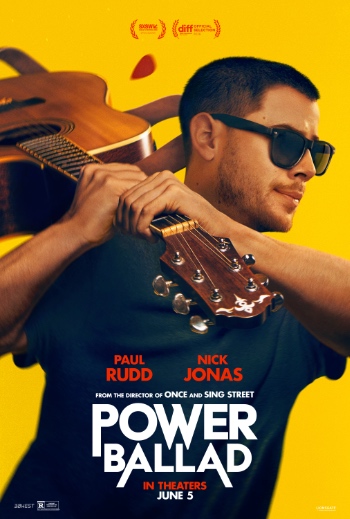
Paul Rudd and Nick Jonas star in Power Ballad
Trailer: Lionsgate
Power Ballad
Directed by John Carney
Rated R
Sung 5 June 2026
#PowerBallad
John Carney’s Power Ballad isn’t his strongest work, but it is a good stroll back down Grafton Street.
The Wedding Singer
Rick Power (the “Power” in the titular Power Ballad) is a singer in a cover band cleverly called Bride & Groove. They specialize in weddings (surprise). It’s a fun setup to start the movie: the band’s rockin’ and rollin’ with popular cover songs and the wedding party’s enjoying the music. But then Rick wants to play one of his former band’s original songs. In his head, he’s playing to a packed arena with excited fans screaming out his name. In reality, the once hoppin’ crowd has dissipated. By the end of the song, only the bride and groom remain on the dance floor.
Nobody’s interested in listening to his original stuff.
As it happens, the newlyweds are friends with a guy named Danny Wilson, who at one point had made it to the big time as a member of a super-successful American boyband. What were they called? Inseparable? Irreparable? Insufferable? Nah. The real name is really lame. Impossible. They’ve requested Danny sing a couple songs with the band and Rick finds it “impossible” to refuse the couple.
Thus begins some sort of friendship, or at least some sort of relationship between new-found frenemies.
During their own private after-party, the two bond over music and Rick plays a song he’s been tinkering with for more than a decade. Danny loves it.
Danny loves it so much, he takes it as his own and uses it to resuscitate his post-boyband career, a career that’s suffered from Danny’s own lack of personal depth and creativity.
As it turns out, 6 months later Danny hits it big with this “power ballad.”
The Gift of Gibson
Rick is played by Paul Rudd, a solid dramatic and comedic performer with an impressive body of work. But is Rudd actually singing? Well, the credits indicate so. Same for the guy playing Danny. That’s none other than Nick Jonas. Of course, it’s expected the member of the very real Jonas Brothers boyband – who are still touring around the world – would be able to sing songs in this acting gig.
Given the pedigree of the talent here, it’s no surprise there’s also a complete, 17-track soundtrack release showcasing the singing chops of both Rudd and Jonas.
The problem is neither one looks like they’re really singing in the movie. Their performances appear lip-synced. Poorly so, to the point of severe distraction. The body movements and the facial motions don’t match the aural performances, which for Rudd in particular seems to be somebody else’s voice altogether.
It’s not all that unusual of a sensation, though. It’s a persistent problem with many musicals, with Madonna’s version of Evita being a low-water mark for the problem, wherein the singing performance and the acting performance are recorded separately with jarring results. (Tom Hooper’s version of Les Miserables is a rather rare example of a movie featuring filmed musical performances. It’s a technically challenging approach, but the results are much, much better.)
Getting past that strange dynamic – regardless of how these scenes were shot and how this effect came about in Power Ballad – John Carney’s latest is a brisk, decent entertainment, but it’s also a lesser work from the mastermind behind Once, Sing Street and Flora and Son.
It’s fun to look back on those movies and see the various patterns, beyond the central element of music. Each has a couple, sometimes a romantic couple, at the heart of the story.
Power Ballad certainly has a couple, but they’re hardly romantic. They’re two musicians living at polar-opposite ends of the financial spectrum. And that’s also where some rather important notions come into play.
Key to Power Ballad is the basic acknowledgement the musician’s life is not easy. Beyond the financial challenges, it’s the demand for creativity. Indeed, the legacy of George Harrison is called out for his having a drawer full of songs to work with in the wake of the Beatles’ bust-up.
It’s without question hard work all around.
Rick – an American living in Ireland for the past 15 years after meeting and marrying the love of his life while on tour with his band (Octagon, which sounds like a hard rock band) – rails against the machine that is the music industry, lamenting how music has become manufactured content. Rock is dead, he says. And he doesn’t even utter “AI.”
Dublin to L.A.
The details and the dialogue Carney and co-writer/co-star Peter McDonald pack into Power Ballad offer plenty of moments worth relishing.
Some of the best lines come from Rick’s 14-year-old daughter, Aja (Beth Fallon in a great feature debut). One involves how girls can no longer be treated like space hardware; they’re more than satellites now.
And it’s his daughter who’s at the heart of the song in question, How to Write a Song (Without You). He wrote it for and about her when she was only 2 years old and he’s been tinkering with it ever since. That’s also where Carney gets into the weeds of songwriting and authenticity. Can Rick really write about a teenage girl alone in her room watching TV? These days, wouldn’t she be on her phone instead?
Those are the small moments that make Power Ballad shine.
The overarching drama surrounding Danny’s theft of the song, though, is a little out of key.
Finishing Line
Having his name on the song that Danny’s stolen and ridden to the top of the charts would change Rick’s life, but he has no recording of his own work before meeting Danny that fateful night. And Danny’s just devious enough to hide the work’s provenance from his manager. That leads to a rather improbable intracontinental confrontation between the two in Danny’s ritzy Hollywood Hills mansion.
But at least the improbability can be (mostly) forgiven given Carney’s heart for music and his characters, particularly Rick. Given its spritely 98-minute runtime, Carney covers a lot of ground and makes Rick a character with a fair amount of depth as a husband, father and bandmate.
On the flip side, Power Ballad is rated “R” for its strong language. That’s a self-inflicted wound for a movie like this. Maybe the “F” bombs add a layer of authenticity given the settings and the characters, but a question lingers as to whether a small movie like this might find a much larger audience if that element had dialed been down or expressed differently. As it stands, it works. It’s not particularly offensive, but it’s a question of theatrical box office impact.
It’s that age-old question of art versus commerce, which is also integral to the story in Power Ballad.
Harking back to that opening wedding scene, as the movie draws to a close, Rick’s at another gig and this time he’s singing the song he wrote that went to number one and everybody loves it. But now, in his mind, it’s only the bride and groom on the dance floor, relishing the intimacy moment because it’s intended to be such a personal song. That’s a really nice turning of the tables.
There’s a lot of heart in that moment and it dovetails nicely with the family bonding that song ultimately brings home.
• Originally published at MovieHabit.com.
Contact 
Write Matt
Visit the Speakers Corner
Subscribe to Mattopia Times
Support 
Help Matt live like a rock star. Support MATTAID.
It's a crazy world and it's only getting crazier. Support human rights.
Search 
The Mattsonian Archives house more than 1,800 pages and 1.6 million words. Start digging.