Movies

New Releases • A-D • E-H • I-P • Q-Z • Articles • Festivals • Interviews • Dark Knight • Indiana Jones • John Wick • MCU
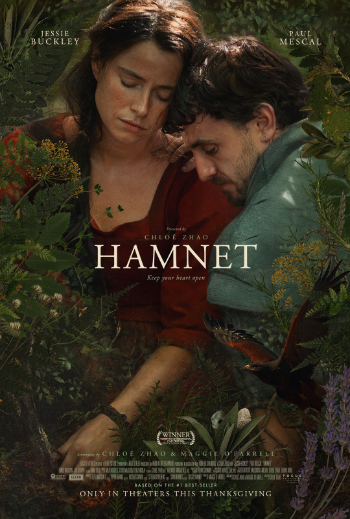
Hamnet, starring
Paul Mescal and Jessie Buckley, directed by Chloe Zhao
Trailer: Focus Features
Hamnet
Directed by Chloe Zhao
Rated PG-13
Written 26 November 2025
#Hamnet
If the question is to see or not to see Hamnet, the answer is a resounding “see.”
Hadestown
Not much is truly known about the life of William Shakespeare; even Walter Isaacson hasn’t tackled that one for his series of genius biographies. When it comes to playwrights, he’s almost universally considered the Greatest of All Time. Some conspiracy theorists, however, posit “Shakespeare” was more of an idea than a singular, living playwright.
By extension, not much can be taken for certain regarding his wife, Anne Hathaway (not to be confused with the contemporary actress from The Dark Knight Rises and The Devil Wears Prada).
Here, she’s called Agnes. The spellings of Agnes and Anne were – back in the day – interchangeable. Similarly, Hamnet and Hamlet were one and the same name.
Hamnet is based on the 2020 novel by Maggie O’Farrell, with a nod to a 2004 New York Review article, The Death of Hamnet and the Making of Hamlet, by Stephen Greenblatt. It’s a surprising and powerfully moving interpretation of what’s known (and not known) that paints Shakespeare and the creation of Hamlet in a noble – even heroic – light. It’s not a “cue the John Williams anthem” kind of heroic. It’s the understated heroism of a father and husband putting the well-being of his kids and wife ahead of his own.
Even as Shakespeare managed to move his brood into one of the largest houses in the Stratford area, he contented himself with a small loft in London while he worked at the Globe theatre and crafted some of the greatest plays – and lines of dialogue – ever written.
Of course, there’s tragedy in Shakespeare’s life. Living in the 16th century was hardly a cakewalk, despite the queen of France offering to “let them eat cake” two centuries later. Colorful embellishments of history are everywhere.
For Shakespeare, though, the challenges were punishing. His son, Hamnet, died of the plague. His father was abusive, even as William worked to pay off his own father’s debts. And his romantic life certainly had its own difficulties.
Shakespeare in Love
Perhaps fittingly, Will and Agnes don’t “meet cute.” They meet kinda hot.
Will’s a man of words, an English tutor. And he’s rendered speechless in Agnes’ presence.
There’s a magnetic attraction between the two, so wonderfully brought to life by Paul Mescal as Will and Jessie Buckley as Agnes. Mescal attracted many eyes with the release of Gladiator II last year. Now it’s finally time for Buckley to get more recognition in the wake of her star-turn in Wild Rose. Her knockout performance here as stoic and tough Agnes raises the stakes for where Buckley goes in a new spin on the bride of Frankenstein next year.
While Will shares with Agnes the story of Orpheus and Eurydice (which also factors into his play Henry VIII by way of an in-play poem), director Chloe Zhao, who won the 2021 directing Oscar for Nomadland, makes some great choices. Not just in the casting, but in some interesting ways of presenting the material – both what’s shown on the screen and what’s not.
Even as Will introduces himself to Agnes, the way they share the screen adds to their cinematic attraction. While Will speaks on-screen, Agnes, in her rather sultry voice, responds off-screen. The dialogue is flirtatious as it is and Zhao’s clever staging gives it even more zip.
Some inferences can be made about Shakespeare by the volume and the quality of his work. In Hamnet, it’s suggested that body of work was created by an inner fire, a need to work and produce something of meaning, something that can put his own past of misery behind him. Putting the creation of Hamlet in relation to the death of his son, then, turns into a really powerful spin on the idea “every artist is a cannibal, every poet is a thief.” As the U2 song The Fly goes, “All kill their inspiration, then sing about their grief.”
Will’s a man who’s lost his way. He’s in love with his wife and children, but he’s painfully dissatisfied with everything else. Shakespeare makes the journey to London in hopes of expanding his father’s leather business, using the theatre scene as his inroads. He needs more in so many ways.
A Midsummer Night’s Dream
Agnes, on the other hand, is seen by the villagers as the undesirable daughter of a forest witch. Will’s mother, Mary (Emily Watson), would rather Will go out to sea and dare the fates out there rather than marry a witch’s daughter.
What makes this all the more fascinating is the movie’s treatment of spirituality and witchcraft. It’s a great spin on the fantastical grounded in reality; this is reality grounded in the fantastical.
Agnes reads hands; she has visions of the future. None of this is handled with the least bit of cheese. The effect is haunting. And this approach extends out to Hamnet as he intercedes for his sister Judith, stepping between her and death and breathing in the pestilence that was wearing her down. It’s an idea that ventures into horror, but Zhao keeps the movie’s footing in the all-too-real history of the plague that ravaged London during Shakespeare’s time.
And, of course, Agnes had been having visions of seeing two daughters at her own death bed, but no son.
Twelfth Night
In retrospect, a couple things stick out as curiosities.
One is the name William Shakespeare is spoken only once, well into the third act.
The other is Hamnet’s general lack of humor. One very funny moment comes to mind as Will offers Agnes a newly made leather glove – a glove made by his own hands in his father’s leather shop. It’s for her and her hawk.
But Agnes – even though she’s a “seer” – simply doesn’t see the point, see a need or see Will’s intentions. She has a glove. It belonged to her mother.
And with that, Will quickly tosses his new glove into the field.
It’s a great moment. And that caring for a hawk becomes a recurring element; Agnes and Will use the hawk as a way of tenderly teaching their children about life and death and hopes and dreams. Stay through the end credits not for a post-credits tease of Shakespeare’s next play, but instead for a very thoughtful final touch: the screech of that hawk.
There is also one clever blink-and-miss-it movie moment. According to the leaflet floating about, the star of this sensational new play called Hamlet that’s generating all sorts of buzz is an actor with the name of Jupe. More about “both of him” in a moment.
Much Ado About Something
Crossing over from life to after-life is poetically shown as a theatre stage. The Globe theatre stage. And the set for Hamlet.
As Shakespeare’s newest play, Hamlet, makes its London debut, the catharsis of the live theatrical experience comes to the fore. The connection between an audience and the collective agonies of the time. There’s a terrific tearing down of the fourth wall as Agnes, standing in the general admission area that is the floor of the Globe, reaches out and holds the hands of the actor playing the fantasy version of her very own son.
That actor playing Hamlet on the stage is Noah Jupe (A Quiet Place) and, in a great Hollywood bit of casting for reality, the boy playing Hamnet is Jacobi Jupe (Peter Pan & Wendy). They are – in reality – brothers.
They’re both terrific. And that pivotal role of Hamnet is not simple. It’s deep, it’s raw. It goes dark. Jacobi proves he has the mettle.
And add two newcomers to this remarkable cast: Olivia Lynes as Hamnet’s sister Judith and Bodhi Rae Breathnach as sister Susanna.
It’s always a sign of a great director when children of such young ages can be guided to deliver such meaningful and genuine performances that resonate.
• Originally published at MovieHabit.com.
Contact 
Write Matt
Visit the Speakers Corner
Subscribe to Mattopia Times
Support 
Help Matt live like a rock star. Support MATTAID.
It's a crazy world and it's only getting crazier. Support human rights.
Search 
The Mattsonian Archives house more than 1,800 pages and 1.6 million words. Start digging.