Movies

New Releases • A-D • E-H • I-P • Q-Z • Articles • Festivals • Interviews • Dark Knight • Indiana Jones • John Wick • MCU
The End of Oak Street, starring Anne Hathaway and Ewan McGregor
Trailer: Warner Bros.
The End of Oak Street
Directed by David Robert Mitchell
Rated PG-13
Consumed 14 August 2026
#TheEndOfOakStreet
The real fun isn’t even in the story or the characters.
Stand By Me
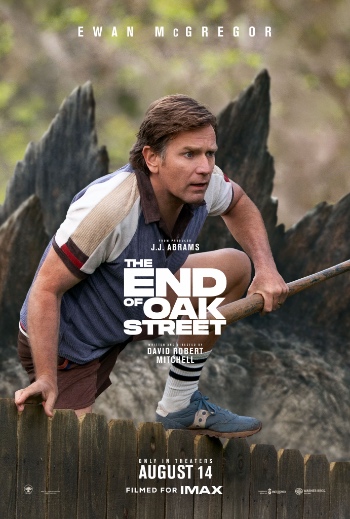
The opening minutes of The End of Oak Street are classic ’80s movies nostalgia. They’re happier times, friendlier times. Neighbors gather for a pleasant block party of lawn games and bar-b-ques. Kids do the unthinkable: they play with their friends outside and go for bike rides around the ’hood.
Of course, there’s always that neighbor who has something to grouse about, his favorite target naturally being the story’s protagonists. But, by and large, the setting is the same as those cozy neighborhoods in Goonies, Poltergeist, Back to the Future, Gremlins, E.T. and so many other movies from that heyday of popular cinema, most having some sort of affiliation with Steven Spielberg.
Aside from the semi-faded color palette of the image, there’s the dated technology. The cars. The pickups. The Polaroid cameras. The phone booths. The clothes.
Yikes! Those tube socks. Those gym shorts.
The horror!
That’s all fine and dandy. But is writer-director David Robert Mitchell going to go anywhere new during this nostalgia trip? It’s a little worrisome because the movie’s a Bad Robot production, with J.J. Abrams serving as one of the producers. Abrams, a master of replication and often labeled as a Spielberg protégé, has lost some of his shine of late, as the afterglow of Star Trek, Westworld and Super 8 dimmed in the wake of his last directorial effort, The Rise of Skywalker.
Well, turns out The End of Oak Street is a surprisingly entertaining and rather “chipper” adventure from a writer/director who’s built his own reputation on horror and adult thriller flicks, It Follows and Under the Silver Lake.
This one’s a family-friendly affair involving a classic nuclear family, a smidge of parental drama, a dose of teenage angst and some dinosaurs.
So. The usual summer fare.
Pete’s Pizza
Let’s get the dinosaurs bit over with. It’s the least interesting – and most ridiculously contrived – element in the movie. There’s some sort of gobbledygook about a freak incident one summer night (it was precisely 11:05 PM, according to the bold red digits on that spiffy digital clock).
High schooler Audrey Platt (Maisy Stella, My Old Ass) is an aspiring astronaut with the cosmos on her brain, literally. She quotes Carl Sagan (“We are like butterflies who flutter for a day and think it is forever.”) while hanging out with her teen peers, none of whom have a clue who the famed Cornell University professor is. After all, New York is a whopping 800 (or so) miles away from the friendly confines of their Michigan neighborhood. She tries to hypothesize the phenomenon that brought on those dinosaurs. Essentially, a portal opened up that sucked the quaint town of Flowervale back into the Jurassic era. There be dinosaurs on those streets!
What to do, then? Is there a way out?
Will the parental units stick together or go their own way?
Actually, while the dinosaur resolution involves a light orb (heel-clicking is not required, but a well-timed leap of faith is), what’s more interesting is the family dynamic and other themes that Mitchell weaves into the story.
Mom, Denise (Anne Hathaway, The Odyssey), is an aspiring writer. But her manuscript, about a woman desperate to leave her family and strike out on her own, doesn’t exactly sit well with Dad, Greg (Ewan McGregor, Obi-Wan Kenobi). He’s a hard-working guy trying to keep the family humming along. As a side gig, he delivers pizzas at odd hours to help pay the bills.
Then there’s the little brother, Brian (Christian Convery, Guillermo Del Toro’s Frankenstein). He’s in big trouble with the local bullies after one of their lowly ilk is injured when Brian manages to throw a stick between a punk’s bicycle wheel spokes, sending the kid flying over the handlebars. That’s a back story situation that is all the more amazing considering Brian continuously proves to be a terrible shot when it comes to his bow, arrows and large targets like dinosaurs in fairly close range.
The dinos themselves aren’t all that spectacular, really. But there is a giant (as in mammoth) serpent that silently slithers through the Platt house, unseen by those who are innocently looking away or turning away. This serpent has an innocent – almost friendly – face, but it’s concealing disgusting, horrifying multiple sets of ultra-sharp fangs.
Pleuromeia, Oh My!
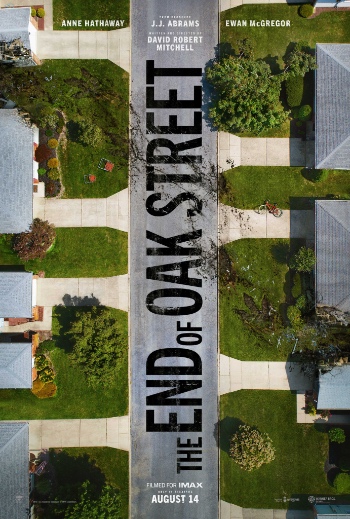
Okay. There’s more to the dinosaurs. While the setup is dicey, the execution makes for a late-summer blast at the movies. Thankfully, Mitchell wholly acknowledges the absurdity of the situation.
To wit, there’s a tender moment of two dinosaurs having “relations,” using a house to provide some balance and leverage. Given it’s certainly not something that’s seen every day, Denise is quick to bust out the Polaroid camera and gets Greg to pose. As he sports a goofy grin and a mallet resting on his shoulder, Denise comments on how she wants to remember this insane, stupid moment.
Kudos.
She got that money shot and it pays off. C’mon. This is an ’80s remake, so it’s perfectly natural to expect not only to have everything turn out all right (at least for all the “right” people), but that everything is wrapped up with a nice little bow around it. (And keep your eyes peeled for Carl Sagan in a meaningful group photo toward the movie’s final frames.)
In that sense, The End of Oak Street hits its mark.
But does it go anywhere new?
Yeah. Sorta.
And that’s largely thanks to Mike Gioulakis, Mitchell’s go-to cinematographer. Take a look at It Follows and Under the Silver Lake (while avoiding his work with M. Night Shyamalan, particularly Old, which seemed to undermine Gioulakis’ skills). Gioulakis’ work with Mitchell is full of interesting frame compositions and terrific imagery. And here it’s particularly fun to watch how the movie is staged. In film theory, it’s breaking the rules if the work draws attention to itself. But, here, it’s part of the fun to consider what is being included in the frame.
A key example involves Denise checking in on a neighbor. Turns out, this beloved neighbor is an early victim of the dinosaurs. As Denise lunges backward and slams against a dresser, the frame is split with Denise on one side of a door while the left side of the frame rests on the other side of the door, where a vintage wedding photo of the now-deceased woman rests atop a cabinet. Counter to Denise’s screams of abject terror, the photo shows smiling faces and much happier times.
Another scene showcases the conspicuous framing of faces. On one side of the frame, a side view of a person speaking rests at the far edge, with a living room picture window filling the majority of the screen. Through the window, kids can be seen playing out on the lawn.
Those elements share the zest for filmmaking and storytelling found in those fun, classic ‘80s movies. The problem is, so many of them have held up so well over the decades, it makes it harder for movies like End of Oak Street to hold their own while still paying homage to those earlier movies.
Pressure Changes
To provide a little something new, Mitchell digs into his bag o’ horror tricks. There are a couple jaw-dropping moments in which characters – which have quickly been established as beloved to the audience or more broadly within the confines of the movie’s neighborhood – are struck down in a virtually instantaneous dino-annihilation. It’s one thing when a meanie has it coming to him; it’s another thing when sweet ol’ so-and-so meets a grisly demise.
And therein Mitchell finds his own pace and imbues his own sensibilities on tried-and-true tropes.
While it would’ve been nice to add a little more heft to the story through social or environmental commentary, Mitchell has some thin strains of those themes running throughout the movie. And he punches at things from a number of different angles, including the introduction of a pretty new girl in town, one who attends a private school. When asked how her school is different from the public school “all” the other kids go to, she states the obvious: she wouldn’t know because private school is all she’s known. Then she asks the big question that seems to be popping up more frequently in movies lately: Do you believe in God?
So, in addition to social and environmental concepts circling this newly created enclave of Flowervale, questions of faith pop up as well. It makes for an interesting experience. It adds some welcome avenues of discussion and trains of thought to this popcorn flick.
The End of Oak Street is such a change of pace from Mitchell, it at the very least establishes him as a director to keep an eye on moving forward. Surely this is a steppingstone – one that follows on his earlier flicks – that will help establish him as one of the more unique talents behind the camera and the keyboard.
• Originally published at MovieHabit.com.
Contact 
Write Matt
Visit the Speakers Corner
Subscribe to Mattopia Times
Support 
Help Matt live like a rock star. Support MATTAID.
It's a crazy world and it's only getting crazier. Support human rights.
Search 
The Mattsonian Archives house more than 1,800 pages and 1.6 million words. Start digging.