Movies

New Releases • A-D • E-H • I-P • Q-Z • Articles • Festivals • Interviews • Dark Knight • Indiana Jones • John Wick • MCU
Dracula, starring Caleb Landry Jones and Christoph Waltz, directed by Luc Besson
Trailer: Vertical / EuropaCorp
Dracula (2026)
Directed by Luc Besson
Rated R
Bitten 6 February 2026
#DraculaMovie
It takes time, but Luc Besson manages to find a new soul for his version of Dracula.
Love Never Dies
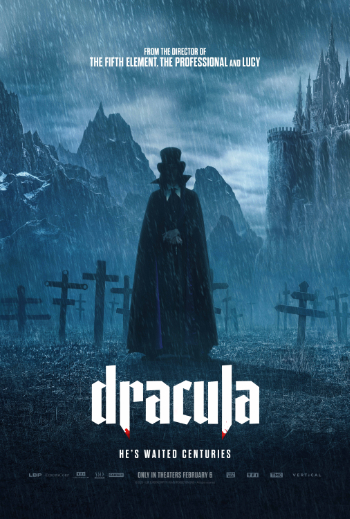
There are plenty of reasons to be both excited and nervous about the prospects of a new Dracula movie from director Luc Besson, working with his own screenplay based on Bram Stoker’s classic novel. After all, Besson’s directed some fantastic films, including the original La Femme Nikita and The Fifth Element.
That’s why it’s a little disconcerting to feel a chill – not from Dracula’s horror – but rather a shudder of disappointment that whisps through as Besson sets the stage with the back story of Vlad the Impaler. It looks a bit like a Gladiator battle on a Red Sonja budget.
More troubling, though, is as Dracula moves forward from 1480 to 1880, there’s a pounding sense of déjà vu. For one, there’s the older Count Dracul’s hair. That long, white hair with the muffin-top do looks so familiar, far too much after the fashion of Gary Oldman’s style in Francis Ford Coppola’s masterful version, Bram Stoker’s Dracula.
And then there’s the score. Why does it sound so much like Wojciech Killar’s effectively haunting and menacing themes in Coppola’s edition? Extra consideration is necessary given this new score’s pedigree. It’s from Danny Elfman, who’s penned so many wildly original scores in the past, including Tim Burton’s Beetlejuice and Pee-wee’s Big Adventure.
It’s a troubling start. Would this turn into another example of Besson gone bad, something like Valerian and the City of a Thousand Planets?
Thankfully, no.
Besson gets some help from some great casting choices as this Dracula simmers and turns more and more savory over time.
Love Is Strong
As Besson’s Dracula mines familiar turf through the first act, there’s an incessant thought running in the background. Why now? What’s new this time?
After all, Coppola’s 1992 version is a visual stunner with a superb cast and then there’s Robert Eggers’ edgy 2024 remake of Nosferatu which pushed hard on the tragic elements of the love story.
Then things start to click. Besson’s humor starts to reveal itself. There are back-to-back sequences that breathe new life into the tale of Dracula. One is darkly comic as Dracula repeatedly throws himself from the top of his castle into the frigid, snowy landscape below. Each time he survives the fall, albeit with a broken bone or two. Even suicide evades this man who makes himself so relatable with this introspective statement: “I am just a poor soul condemned by God and cursed to walk in the shadow of death for all eternity. And sustain myself on fresh blood. Human blood is recommended.”
Following that dark scene comes the light. The movie’s scope expands to world travel as Dracula embarks on a new strategy to find his one true love, Elisabeta (Zoe Bleu). He scours the globe for the best in potions and perfumes and lands on a highly effective (and humorous) concoction.
There’s the humor.
The pace picks up. The optimism rises. Elfman finds fresh themes.
And Caleb Landry Jones takes ownership of the role of the Prince of Wallachia. He seems so seasoned, aided and abetted by some great makeup effects to convey 400 years of wear and tear on a troubled soul. It’s easy to lose sight of the 36-year-old’s background. The actor, who’s appeared in Get Out and Three Billboards Outside Ebbing, Missouri, also starred in Besson’s DogMan. He’s from Garland, Texas, not Eastern Europe. Those same scenes which introduce the Count in that white hairdo and recount the Count’s tragic love story also start the process to separate Jones from Oldman and Bill Skarsgard’s Count Orlok.
Dracula draws in a harem of beautiful women through the centuries; they’re enlisted to help him find Elisabeta, whom he posits possesses a soul so pure it must be resurrected for a better fate. One of those agents in Dracula’s service is a beautiful young woman named Maria. Her initial appearance electrifies the screen as it lights up with an exciting new energy. Matilda De Angelis, the Italian star of Robbing Mussolini, manages to – sorry, it must be said and it must be said this way – sink her teeth into her role. Her introduction is fun. Her final scene is jaw-dropping and one that helps this Dracula find its own place in the pantheon of the legend’s interpretations.
In the Name of Love
In addition to Jones and De Angelis, Besson enlists two-time Oscar winner Christoph Waltz as the priest who follows centuries of divine investigatory work to finally settle the Count’s tragedy. As the priest, Waltz brings a calm, grounded presence that works as a balance to the darkness and the dark humor.
As this telling unfolds, all the usual elements are there, sure enough.
There’s one particular scene, though, that leads to thoughts of an unexploited opportunity. As Dracula invites Jonathan Harker (Ewens Abid) to a not entirely pleasant dinner, the two walk through a massive, dimly lit dining hall. The cavernous walls are adorned with full-figure portraits of the Count that would seem to show a progression of his age through the centuries. It could’ve been a creepy, haunting (even darkly humorous) touch to reveal more of those paintings instead of all-too-quickly passing them by with merely a brief, cropped glimpse of their content.
But, as that question of “what’s new” lingers in the background, there are also times when Besson seems to tease of contemporary topics and challenges. Maybe it’s a matter of the mind getting ahead of itself, but there seem to be veiled references to #MeToo (Besson faced his own legal challenges), Covid, Jeffrey Epstein, immigration and, of course, religious conflicts. And Dracula’s gargoyles could be interpreted in a couple different ways – one in particular with sinister religious undertones – with their surprise climactic reveal.
Having endured the plague and the loss of 200 million people, Vlad still laments, “Living without love is the worst disease of all.” His final confrontation with the rational priest makes for a great resetting of reality. Did God curse Vlad? Or was the priest sent to save his soul? As the priest says, “You are not fighting God, my son, you are fighting yourself… We live and we breathe in His name. Why would He want us to destroy His creation? Man kills in his own name. And you are doing it again.”
The climax of Besson’s Dracula does a nice job of bringing the Count’s story back to his bloody Impaler roots. It’s a story of damnation and redemption that doesn’t quite match the searing impact of Eggers’ Nosferatu; that’s a mighty feat to try to top and Besson doesn’t have to as he finds his own powerful conclusion.
Besson tells the Dracula tale his way and that’s satisfying enough.
• Originally published at MovieHabit.com.
Contact 
Write Matt
Visit the Speakers Corner
Subscribe to Mattopia Times
Support 
Help Matt live like a rock star. Support MATTAID.
It's a crazy world and it's only getting crazier. Support human rights.
Search 
The Mattsonian Archives house more than 1,800 pages and 1.6 million words. Start digging.