Movies

New Releases • A-D • E-H • I-P • Q-Z • Articles • Festivals • Interviews • Dark Knight • Indiana Jones • John Wick • MCU
The Death of Robin Hood, starring Hugh Jackman, Jodie Comer and Bill Skarsgard
Trailer: A24
The Death of Robin Hood
Directed by Michael Sarnoski
Rated R
Expired 19 June 2026
#DeathOfRobinHood
This punch-drunk revisionist spin on the Robin Hood legend steals from history without giving much to the present.
I Shot the Sheriff
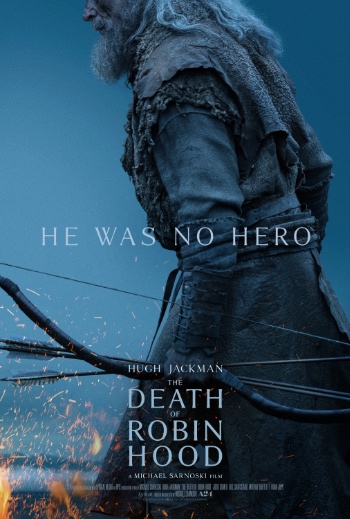
It’s ironic this movie about the stories people create and the real actions that inspire them has such a hard time spinning its own story.
The Death of Robin Hood is a dark movie. It’s mostly dark imagery. It’s nearly entirely dark thoughts.
Writer/director Michael Sarnoski is swimming upstream here, flailing against the tide of pop culture to assert a revisionist take on a wholly fictional character as if he were a real bandit whose efforts caused more harm than good. Beyond all the pop culture folklore through the centuries, there are all those Hollywood movie legends of Robin Hood populated with a constellation of stars including (to name but a few) Kevin Costner, Russell Crowe, Errol Flynn, Taron Egerton, even Cary Elwes in Mel Brooks’ farce and, of course, Disney’s animated fox.
The Death of Robin Hood is a distinctly and decidedly different sort of tale. There are no Merry Men. No Sheriff of Nottingham. No Maid Marian (she never even existed, according to this version). No Friar Tuck. But there is a Little John and loads of grisly violence. The opening scenes are chock full o’ brutal, graphic savagery shot on Northern Ireland’s frigid, rocky terrain.
This is an arrow-shot-through-the-back-of-the-head-and-out-the-right-eye kind of on-screen gore.
In the afterglow of their pillaging adventures, Robin Hood (please, call him Randolph) and Little John (it’s Edward, thank you very much) seem unable to discern their own facts from their own fictions. Their real lives have been intertwined with the legends they’ve inspired (or maybe even told to juice up their influencer status in a pre-social media world) to the point where they can’t even assert definitively whether they ever met such-and-such a person or been to such-and-such a place.
But they’re also working on their own storytelling chops. Robin… sorry, Randolph, wants Edward to paint a picture of his wife for him. Paint a picture with words.
No.
Her hair is not red like blood.
It’s red like the setting summer sun.
Beautiful.
Such poetry from such barbarians.
Social Distortion
Sarnoski, who wrote and directed A Quiet Place: Day One while completely sidestepping the basics of what would really happen on the first day of an alien invasion, this time chooses to upend all of Robin Hood’s legends of yore. He’s no longer a hero; he no longer takes from the rich and gives to the poor. Instead, he kills and plunders and moves on with no song and dance. No aid to the meek.
That’s all because Sarnoski, as he himself explains it, at some point stumbled on contrarian (and contradictory) tales of a Robin Hood who was a monster, of a Robin Hood who was murdered by a prioress. Those tales stand in stark contrast to the bounty of other tales of a heroic figure, a bright spark to illuminate dark times.
Sarnoski focuses on an extremely negative take on Robin Hood that – upon further research beyond the movie’s press materials – gained traction in 18th century England, which was in the thick of an unprecedented crime wave. Given the times, the mindset, the politics and the elapsed centuries, think of it as the 1700s version of today’s cancel culture.
This dark view of Robin certainly adds to the mystique, but it also doesn’t lend itself to greater credibility, given it is also centuries removed from the days of his glorious (or inglorious) adventures. (The setting for The Death of Robin Hood is “Anno Domini 1247.”)
Further muddying the waters, there are indications Robin Hood was at that time taken on as an alias by dozens upon dozens of thieves and hoodlums. Think of them as the Middle Ages version of scammers and phishers further obfuscating confusing circumstances and blurring reality.
That all leads to Sarnoski’s Robin Hood finding himself trapped in his own legend. A bad man who put in motion the violent retribution of others, a cascading legacy of devastation with the potential to be handed down from generation to generation.
Assassin’s Creed
In the thick of the Middle Ages, with the vast majority of people living in and locked under a feudal system, would there be a point to having a legend about a man who stole from the rich (and apparently squandered it all)… and murdered and pillaged… instead of the popular legend of a man who stole from the rich and gave to the poor? In today’s divisive political parlance driven by socialist ideologies, Robin Hood is practically the pinnacle of the “eat the rich” mindset.
Sure, Sarnoski – rightly so – describes the 13th century as a hard time to be alive. That’s a given. Well documented. Wholly understood.
And that also makes the story of a hero more compelling than the story of a plague-like monster. (There’s not even the shadow of a doubt those monsters were out there. And maybe some of them went by that alias of “Robin Hood.”)
But was Robin Hood – a figure seeded in Sir Walter Scott’s Ivanhoe – even a real human being? Nope. Not likely. Maybe this “idea” of the man was inspired by real people and real situations, but there was no such distinct living human being. He’s the stuff of folklore, much like the magical legends of King Arthur.
But. Fine. Sarnoski wants to fixate on this version of Robin Hood being a bad man (one who had never prayed even once in his life) in search of redemption before he dies, further modified to suggest an alternative motive related to his titular death. Sarnoski’s work so far suggests he’s a skilled filmmaker, but that doesn’t make him a cogent, convincing storyteller.
These lads – Randolph and Edward – would never run from a knife fight, but they seem to have a deep and abiding aversion to the truth and facts. Even Randolph’s own recounting of when he first met Edward (two stubborn men trying to cross paths on a bridge) doesn’t seem to logically connect with his explanation for why John was called “Little.”
Drunk History
Calling this The Death of Robin Hood seems like a cheat, a shortcut to setting the stage for a story would be better served standing on its own, with different characters free of all the baggage. The elements of something compelling are all there: the brutal setting, the influence of storytelling to sway opinion, the reality of violence as a fuel for vengeance and the need to rise above it all. There is an opportunity here to tell a story of the 13th century that holds a mirror up to life in the 21st.
In its current form, though, it’s an unnecessary story to tell.
In terms of the filmmaking, Sarnoski does a great job of creating a sense of time and place, slightly marred by all the precisely placed makeup to grunge-down the cast. But that cast is terrific, with Hugh Jackman leading the charge as Randolph (formerly Robin Hood), Bill Skarsgard as Edward (formerly Little John) and Jodie Comer as Prioress Brigid.
They have the chops to bring the grit to life.
And Sarnoski drops in nice, artful touches.
For one, there is a shift in aspect ratios, with the opening scenes of death and destruction shot in a scope ratio followed by the bulk of the movie – as set at the priory – captured in 1.85:1 (or thereabouts).
It’s certainly well-crafted and staged, so the technical aspects are sound. It’s the storytelling – which is ultimately the very heart of this endeavor – which is challenging to appreciate.
• Originally published at MovieHabit.com.
Contact 
Write Matt
Visit the Speakers Corner
Subscribe to Mattopia Times
Support 
Help Matt live like a rock star. Support MATTAID.
It's a crazy world and it's only getting crazier. Support human rights.
Search 
The Mattsonian Archives house more than 1,800 pages and 1.6 million words. Start digging.