Movies

New Releases • A-D • E-H • I-P • Q-Z • Articles • Festivals • Interviews • Dark Knight • Indiana Jones • MCU
The Da Vinci Controversy:
Next Year's Macarena Is Hot News Today
"It's only a movie."
— Alfred Hitchcock
The Ultimate Conspiracy Theory
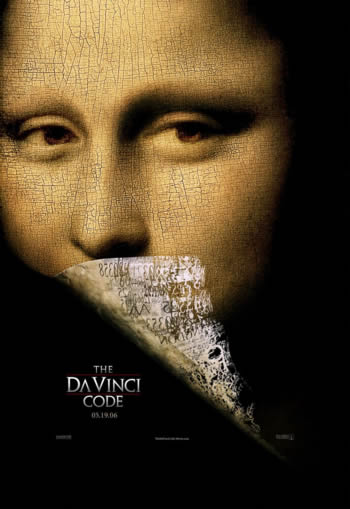
Dan Brown's The Da Vinci Code is a mostly clever dime novel that reached, dare I say, "cult" status with 46-66 million copies in print worldwide (when the numbers get that big, it's easy to lose track of the count). By tapping into an alternative view of what transpired 2,000 years ago and the basic precepts that have guided millions upon millions of believers for centuries, his story could be billed as the ultimate conspiracy theory.
Nonetheless, it would be silly for anybody to take the book's theories as, well, gospel. Instead, it should be thought of as a fun little lark, a globetrotting romp akin to the metaphysical adventures of Indiana Jones… minus the chilled monkey brains.
In my opinion, The Da Vinci Code doesn't attack pure matters of faith. If anything is "attacked," to use a rather aggressive term, it is the manmade institutions and interpretations that have been built up subsequent to those historic matters of faith.
Even so, Brown's book is hardly deserving of all the notoriety — and accolades — bestowed upon it. After all, in one early passage, Brown concocts an easy escape for his protagonists by stuffing a GPS beacon in a bar of soap found in the Louvre's men's room and tossing it out the window onto a passing truck.
Come now, Mr. Brown. Going to the Louvre's loo is virtually a rite of passage for any backpacker and, having been there a couple times in the past few years, I have no recollection of bars of soap. They have those new-fangled liquid soap dispensers.
If he cheats on something that recent, dear reader, then how can he possibly be taken as knowledgeable about what happened 2,000 years ago?
Unfortunately, for the majority in a recent survey of British readers, what Brown has written is considered factual. Then again, we must remember that those folks across the pond are the same clan whose most successful contribution to culture recently is their Pop Idol export, the faux talent extravaganza American Idol.
The Mattphisto Code
Things have mushroomed to the point where The Da Vinci Code is its own cottage industry. A recent count of the four primary New York Times best seller lists (representing a total of 60 titles, fiction and nonfiction) found 10 books related in some way to Dan Brown, the Grail, the Knights Templar, or other elements of The Da Vinci Code; that's one out of every six titles.
With that in mind, it would seem people are hungry for more information; that's a cash cow the church should tap into rather than fight against with boycotts and requests for disclaimers.
Furthermore, for the past few months, cable channels like National Geographic, The Science Channel, Biography, and The History Channel have been chock full o' shows on topics related to The Da Vinci Code. With a fair amount of credibility, most of those shows have gone through, point by point, and debunked every last theory contained in Brown's book, including that major Holy Grail plot point (and that bar of soap). One of the items on Brown's "fact page" regards the Priory of Sion. If he had relied on a little more than Holy Blood, Holy Grail, he might have realized the whole priory theme was a hoax, with the perpetrator's name found in the very same text he "discovered."
Don't get me wrong. I really enjoyed reading The Da Vinci Code. In fact, I'd even like to grow up to be a symbologist some day and find myself in exciting situations with Audrey Tautou. But, please, no midnight emergency phone calls pulling me out of blissful slumber. I've already had one Parisian visit interrupted by a business emergency and it was annoying. If you do have an emergency, please phone between the hours of 10 a.m. and 4 p.m. only.
(By the way, my "emergency" had nothing to do with murderous albinos or hidden messages in works of art; it had to do with a software project. Software's not sexy. Symbology is tres, tres sexy.)
It's a Crazy World
Having now contributed to the glut of words written about The Da Vinci Code, here's more: a brief rundown of the mania surrounding the movie's release, plus a few other tangentially related points to provide more food for thought.
- It can be argued that the Roman Catholic Church's response to The Da Vinci Code has been more vociferous than its response to the Holocaust.
- In the "prequel" to The Da Vinci Code, Angels & Demons, Robert Langdon actually works tirelessly to save Vatican City — and its massive art collection — from destruction by the Illuminati.
- James Frey, author of A Million Little Pieces and My Friend Leonard, has almost single-handedly redefined "non-fiction" by lacing his memoirs with extensive sections of "embellishment."
- The back cover of The Da Vinci Code's paperback edition clearly labels it as "fiction" and the book is (or should be) stocked on shelves accordingly.
- The movies Eyes Wide Shut and The Last Temptation of Christ feature some of the same topical material.
- Isn't the church supposed to lead by example?
- The Roman Catholic Church's borderline cover up response to the pedophilia scandals in the U.S. is precisely the kind of secretive atmosphere that at least in part encourages works such as The Da Vinci Code and gives them that much more credence.
- Cardinal Roger Mahony has found himself in the thick of scandal, complete with potentially perjurous testimony during a sex abuse investigation.
- Gerald Robinson, a Catholic priest, was recently convicted of stabbing a nun to death.
- Justice Peter Smith, a British judge who ruled in favor of Brown during a recent copyright suit, took the opportunity to embed the "Smithy Code" in his ruling. The code, featuring conspicuously italicized letters peppered intermittently throughout the justice's ruling, was ultimately decoded by a couple intrepid journalists using the same Fibonacci Sequence used by Robert Langdon during his da Vinci adventure.
- Some protestors of the movie in Mumbai, India, vowed to stage a hunger strike until death.
- In addition to India, protests have been held in South Korea, Greece, and the Philippines. The latter might also ban the film entirely.
- One person in Mumbai even offered a cash reward for the murder of Dan Brown.
- Don't forget Salman Rushdie and the fatwah that was issued against him following the publication of The Satanic Verses.
- Censors in Thailand were going to cut the last 10 minutes from the movie, effectively leaving audiences in the dark as to the final revelations of the code. They later changed their minds.
- Archbishop Philip Wilson, of Adelaide, Australia, has reportedly taken a different approach by saying, "The church has a responsibility to help people to see the truth or not of what's being proposed." That is a far more cogent response. People are clearly clamoring for more information; don't simply slam the door on a great opportunity for discussion.
- Another sound response comes from a Malaysian Christian coalition official who, allegedly, said his group will not try to ban the film on the grounds that "we believe that if the Bible is the truth of God, we are not afraid of any attempt to discredit it."
- The Coen brothers' movie Fargo opens with a preface claiming it's "a true story."
- The Da Vinci Code is a fun bit of pop culture that will probably be next year's Macarena.
Finally, remember that The Da Vinci Code was written by the same guy who wrote the following snicker-inducing line in Angels & Demons: "Langdon gave an exhausted smile and reminded her that it was she who deserved thanks — her ability to practically dislocate her shoulders had just saved them both."
• Originally published at MovieHabit.com.
Contact 
Write Matt
Visit the Speakers Corner
Subscribe to Mattopia Times
Support 
Help Matt live like a rock star. Support MATTAID.
It's a crazy world and it's only getting crazier. Support human rights.
Search 
The Mattsonian Archives house more than 1,700 pages and 1.5 million words. Start digging.